

Summing Up The Week
A week of economic crosscurrents left investors squinting at the data, trying to make sense of a market that kept rallying even as the headlines refused to line up. July’s inflation readings landed with a welcome thud as CPI barely budged and PPI came in cooler than feared, both easing worries that wartime energy spikes might reignite price pressures.
But that relief was quickly tempered by an unexpected drop in retail sales, a reminder that consumer momentum may be wobbling just as geopolitical uncertainty intensifies. With stocks rising on good news, shrugging off bad news, and hesitating on mixed news, the market’s message heading into mid‑August is clear: sentiment is fragile, direction is elusive, and every new data point has the potential to flip the narrative again.
Let's take a deeper dive into the news that moved markets this week...
Market News
Consumer prices rose 0.1% in July in line with expectations
On Wednesday, the Consumer Price Index (CPI) showed an increase in prices of 0.1% in July, putting the annual inflation rate at 3.4% which was in-line with Dow Jones' estimates, reported CNBC. While the Federal Reserve continues to maintain a target inflation rate of 2%, the market was concerned the spike in energy costs due to the U.S.-Iran War could have dramatically negatively affected the inflation rate and these concerns were allayed by the CPI print.
"In-line inflation will keep the 'no need to hike rates' narrative that took hold after last week’s jobs report intact," said Chief Economic Strategist Ellen Zentner for Morgan Stanley Wealth Management. "There will be another round of inflation data before the September FOMC meeting, so the storyline could still change. But unless those numbers tell a much different story, the Fed will likely still be in a position to leave rates unchanged next month."
Stocks rose at the open in Wednesday trading following the cooler-than-feared report.
Producer prices come in flat for July, better than expectations
On Thursday, the Producer Price Index (PPI) delivered a positive surprise with inflation in July remaining unchanged at 4.7% on an annual basis versus expectations for a 0.2% increase to 4.9%, reported CNBC. It's certainly worth noting that 4.7% is significantly higher than the Fed's 2% target rate (even though the Fed's target is for consumers and not producers, typically).
"Net, net, pipeline pressures at the lower stages of production are not adding to the inflation risks the consumer faces," said Chris Rupkey, Chief Economist at Fwdbonds. “"t counts as good news that for a second consecutive month, PPI final demand prices have not gone up adding to the cost of living crisis faced by Americans."
The market rallied even higher than it did on Wednesday on the back of the PPI report.
Retail sales dropped -0.6% in July vs +0.01% estimate
On Friday, July's retail sales numbers showed a surprise drop of -0.6% in July against Dow Jones' estimates calling for a +0.01% rise, reported CNBC. After treasury yields rose following a poor bond auction on Thursday, they remained surprisingly steady even when the U.S. said its blockade of Iran's ports on the Strait of Hormuz could continue "indefinitely" with the 10-year treasury yield rising less than 1 basis point at 4.645% and the 2-year actually pulling back 2 basis points to 4.117%.
Apparently, the market is a bit confused by all the mixed messaging, too. The S&P 500 and Nasdaq both opened relatively flat on Friday morning after rallying for much of the last half of the week.
Next Week's Gameplan
Next week brings tamer datapoints like the homebuilder confidence index on Monday; housing starts on Tuesday; the Fed's July meeting minutes on Wednesday; and S&P flash services and manufacturing PMIs on Friday. Also, while we're not done with earnings season, yet, I have absolutely no positions reporting next week, either, so I have no real news to go on to get a feel for market action.
If next week is anything like this week, though, the market will continue to float higher as low summer volumes typically keep the market moving in the direction of the current momentum. Of course, that being said, there's still no resolution to the U.S.-Iran War so there are plenty of unknown-knowns and unknown-unknowns which could come our way so stay tuned and join me back here next Friday, friends!
Check out Get Irked Premium on Substack!
After providing FREE content since 2018, the time constraints of producing Investments in Play, Speculation in Play, the Pandemic Portfolio, and Stock Shopping List have become too much to continue doing for free.
On Substack, you can subscribe for FREE to have the Week in Review and Crypto Corner, now separate newsletters, sent to your email inbox at no cost. The portfolio updates and Stock Shopping List are now part of a premium subscription plan.
I hope you will join me on Substack as I continue on this exciting journey!
THANK YOU FOR YOUR ONGOING SUPPORT!
Crytpo Corner
Click chart for enlarged version
Bitcoin Price (in USD)
%
Weekly Change
Bitcoin Price Action
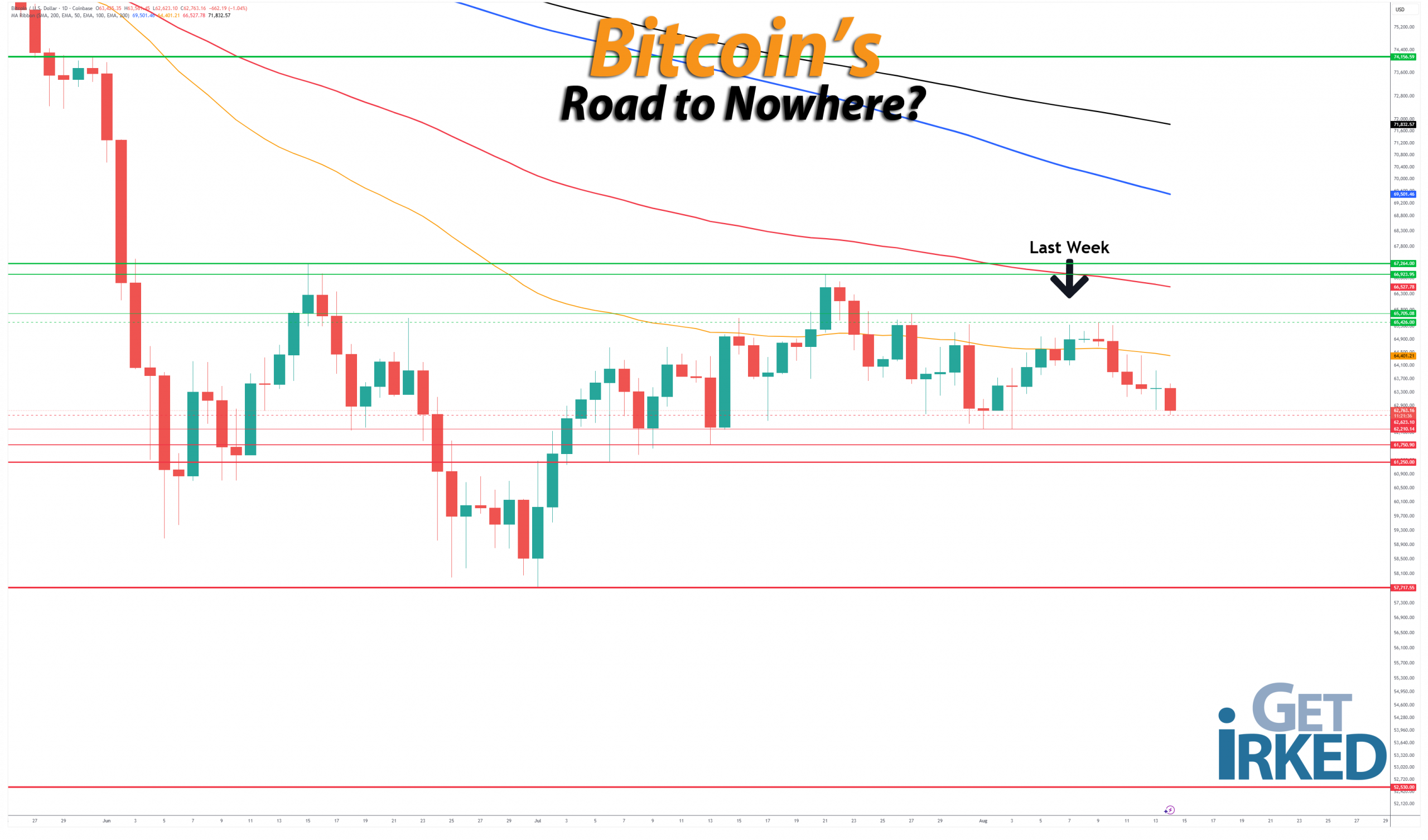
Bitcoin made very little progress this week, squeaking out the most minor higher weekly-high at $65,426.00 on Sunday before losing support and falling back into the range it’s been trading in for weeks now. Bitcoin did manage to make a slightly higher weekly low at $62,623.10 on Friday as I went to print on this update, but that’s not exactly confidence inspiring given last week’s low was only $400 lower.
The Bulls continue to argue this price action indicates Bitcoin buyers are building up the support level before heading higher. Some prominent Bulls are going so far as to argue that a massive descending triangle formation - which is very much a bearish pattern - is actually bullish. This Bull, in particular, argues that this descending triangle indicates a huge breakout coming for both Bitcoin and major altcoins like Ether (no, the account provides no indication why they think this time a bearish pattern is actually bullish… it’s baffling, really).
The critical element to remember is this: Bitcoin does NOT trade like a stock, bond, or commodity. Bitcoin is its own entity.
Unlike other assets where a long period of price consolidation typically leads to a “the longer the base, the higher in space” bull scenario ending in a huge upside breakout, Bitcoin does not operate like that.
In every other prior Crypto Winter, Bitcoin will consolidate within a range for weeks, more often months, and that consolidation only serves to weaken the support level for the entire time before support finally breaks and gives out.
-
In 2018, Bitcoin traded with $6,000 as support from January through November before the support broke and dropped Bitcoin nearly another -50% to its $3,130 low.
-
In 2022, Bitcoin traded with $30K-$35K as support from January through June before the support weakened, finally broke, and sent Bitcoin down nearly -50% further to its $15,470 low.
Now, Bitcoin has been trading with the $60,000 level as support since February, yet the Bulls are arguing the bottom is in and Bitcoin will only head higher from here.
We’ve seen this exact same story play out twice before in the past eight years. Why would this time result in a different outcome? By all reasonable studies, it won’t. Lower lows are likely in store in the coming days, weeks, or months.
I keep reading both Bulls’ and Bears’ perspectives and even many of the Bears feel overly optimistic to me with most believing Bitcoin’s target low to be around $48,000 for this Crypto Winter.
That would give us a total selloff from the all-time high of right around -62.90%, almost precisely where Bitcoin sold off from its then-high to the low during the Pandemic Crash in March 2020.
But, here’s the thing: Bitcoin wasn’t in a Crypto Winter in 2020. In fact, it had bottomed and was about to rally into the next bull cycle. Without the Black Swan Event of COVID-19, Bitcoin’s cycle would have remained uninterrupted as it rallied to its 2021 high.
Right now, Bitcoin is in a Crypto Winter and even -62.90% would be far too shallow comparative to all prior cycles where Bitcoin sold off a minimum of -77% from its all-time high before bottoming.
While I will be buying all the way down with my first buy right around the $58K level, I continue to believe we’ll see a much lower-low than $48K. Based on prior cycles and the fact that each subsequent Crypto Winter has been shallower than the last, I continue believe Bitcoin needs to sell off at least -70% from its $126,000 which gives us a minimum low-end target of $37,800.
I absolutely could be wrong. In fact, I hope I’m wrong considering how much of my net worth is tied up in crypto (even now down -50% from all-time highs). Regardless, it’s starting to get exciting sports fans as we head deeper into what should be the end of the Crypto Winter.
The Bullish Case
Bulls
The Bearish Case
Bears
Bitcoin Trade Update
Premium subscribers to Get Irked get access to all the moves I've made in my Bitcoin trade over the past week as well as my next thirty (30) ... yes, 30 ... buys in Bitcoin including price levels, quantities, and a full layout of my ongoing long-term trade in the world's biggest crypto.
Not Your Keys, Not Your Crypto...
In light of brokerage failures in 2022, I no longer keep any of my crypto on an exchange and I only keep enough USD on the exchanges I use to execute my next few buys. I use multiple cold wallets from the brands Ledger and Trezor to hold my crypto (click the links to access the direct sites, and I receive no affiliate benefits from these links).
No price target is unrealistic in the cryptocurrency space – Bullish or Bearish.
While traditional stock market investors and traders may think the price targets in the cryptocurrency space are outlandish due to the incredible spread (possible moves include drops of -90% or more and gains of +1000% or more), Bitcoin has demonstrated that, more than any speculative asset, its price is capable of doing anything.
Here are some of Bitcoin's price movements over the past couple of years:
- In 2017, Bitcoin rose +2,707% from its January low of $734.64 to make an all-time high of $19,891.99 in December.
- Then, Bitcoin crashed nearly -85% from its high to a December 2018 low of $3128.89.
- In the first half of 2019, Bitcoin rallied +343% to $13,868.44.
- In December, Bitcoin crashed -54% to a low of $6430.00 in December 2019.
- In February 2020, Bitcoin rallied +64% to $10,522.51.
- In March , Bitcoin crashed nearly -63% to a low of $3858.00, mostly in 24 hours.
- Then, Bitcoin rallied +988% to a new all-time high of $41,986.37 in January 2021.
- Later in January 2021, Bitcoin dropped -32% to a low of $28,732.00.
- In February, Bitcoin rallied +103% to a new all-time high of $58,367.00.
- Later in February, Bitcoin dropped -26% to a low of $43,016.00.
- In April , Bitcoin rallied +51% to a new all-time high of $64,896.75.
- In June , Bitcoin crashed -56% to a low of $28,800.00.
- In November, Bitcoin rallied +140% to a new all-time high of $69,000.00.
- In November 2022, Bitcoin crashed -78% to a low of $15,460.00.
- In April 2023, Bitcoin rallied +101% to a high of $31,050.00.
- In June, Bitcoin dropped -20% to a low of $24,750.00
- In July, Bitcoin rallied +29% to a high of $31,862.21.
- In September, Bitcoin dropped -22% to a low of $24,900.00.
- In January 2024, Bitcoin rallied +97% to a high of $49,102.29.
- Later in January, Bitcoin dropped -22% to a low of $38,501.00.
- In March, Bitcoin rallied +92% to a new all-time high of $73,835.57.
- In August, Bitcoin dropped -33% to a low of $49,050.01.
- In January 2025, Bitcoin rallied +150% to a new all-time high of $109,358.01.
- In April, Bitcoin dropped -32% to a low of $74,420.69.
- In May, Bitcoin rallied +51% to a new all-time high of $112,000.00.
- In June, Bitcoin dropped -12% to a low of $98,247.01.
- In July, Bitcoin rallied +25% to a new all-time high of $123,231.07.
- In September, Bitcoin dropped -14% to a low of $107,250.00.
- In October, Bitcoin rallied +18% to a new all-time high of $126,296.00.
- In July 2026, Bitcoin dropped -54% to a low of $57,717.55.
Where will Bitcoin go from here? Truly, anything is possible…
What if Bitcoin’s headed to zero?
The only reason I speculate in the cryptocurrency space is I truly believe Bitcoin isn’t headed to zero.
I am prepared for that possibility, however, by knowing I could potentially lose all of the capital I’ve allocated to this speculative investment. Professional advisers recommend speculating with no more than 5% of an investor’s overall assets. Personally, I’ve allocated less than that to speculating in crypto.
I feel that anyone who doesn’t fully believe in the long-term viability of cryptocurrency would be better served not speculating in the space.
On a good day, this asset class isn’t suitable for those with weak stomachs. On volatile days, the sector can induce nausea in the most iron-willed speculator. If a speculator isn’t confident in the space, the moves will cause mistakes to be made.
DISCLAIMER: Anyone considering speculating in the crypto sector should only do so with funds they are prepared to lose completely. All interested individuals should consult a professional financial adviser to see if speculation is right for them. No Get Irked contributor is a financial professional of any kind.
Ways to give back to GetIrked:
Send me a tip via Stripe! Thank you!
Get free money by signing up for an account with my referral link for Schwab
Sign up for Gemini and we each get $10
Click this referral link to get the Brave Browser
If you use Brave, you can also use the Tip function to tip me in Basic Attention Token (BAT).
Suicide Hotline - You Are Not Alone
Studies show that economic recessions cause an increase in suicide, especially when combined with thoughts of loneliness and anxiety.
If you or someone you know are having thoughts of suicide or self-harm, please contact the National Suicide Prevention Lifeline by visiting www.suicidepreventionlifeline.org or calling 1-800-273-TALK.
The hotline is open 24 hours a day, 7 days a week.

You must be logged in to post a comment.