
Summing Up The Week
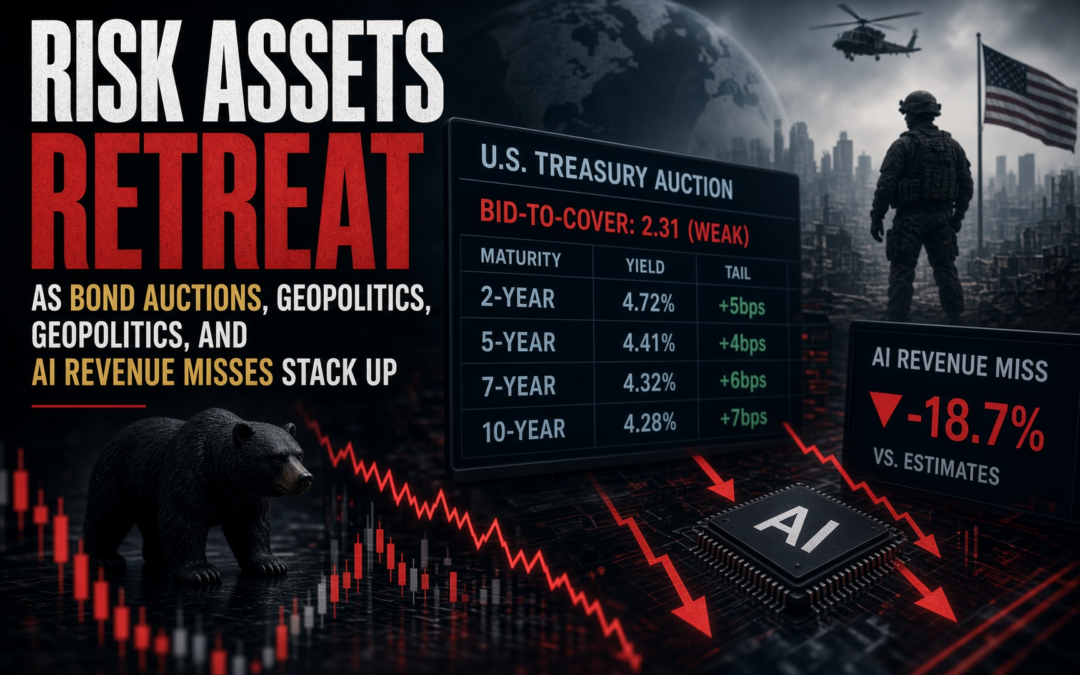
The stock market glided higher early in the week, but the calm didn’t last. By mid‑week, a surge in the 10‑year Treasury yield to its highest level since 2002 shattered the rally and reminded investors just how fragile sentiment remains.
Bond‑market jitters, a data‑dependent Fed signaling another rate hike, a sharp spike in oil prices driven by escalating tensions in the Strait of Hormuz, and fresh anxiety across the AI sector after OpenAI’s disappointing revenue update all converged to rattle risk assets.
Even as stocks found pockets of relief, the backdrop grew darker with new data showing U.S. household debt stress rising to levels not seen since the Great Recession, a warning flare for the broader economy that investors can’t afford to ignore.
Let's take a deeper dive into the news that move stocks this week...
Market News
10-Year Treasury hits highest yield since 2002
The stock market seemed to be moving through the week swimmingly with a rally taking it both through Monday and Tuesday trading. This was all broken when, on Wednesday, the 10-year Treasury note yield rose to 5.35%, its highest level since 2002, and caused equity investors to get nervous about the day's upcoming bond auction, reported CNBC.
While Tuesday's bond auction received good marks in terms of demand for U.S. debt, experts were a bit more apprehensive about Wednesday's. "We were encouraged by the takedown of Tuesday’s 3-year auction supply – which stopped through slightly but didn’t tail as had been the previous streak for coupon auctions," said BMO’s Head of U.S. Rates Strategy Ian Lyngen in a note at Tuesday’s close. "It goes without saying that [Wednesday’s] 10-year supply is far more relevant for setting the tone in US rates. Notwithstanding the solid reception to the 3-year supply, we’ll look for an auction concession of significance ahead of the reopening of 10s – either outright or on the curve."
Ass a result, risk equities - including Bitcoin - all pulled back at the open during Wednesday's trading ahead of the auction and the release of the Federal Reserve's most recent meeting minutes later in the day.
The Fed sees another hike but no idea when it will happen
Wednesday was busy because, after the 10-year yield's high hit, the Federal Reserve's meeting minutes showed the members believe another interest rate hike is coming with no idea when, reported CNBC.
The minutes clearly pointed to a rate hike stating, "With regard to the outlook for monetary policy beyond the current meeting, most participants assessed that another increase in the target range for the federal funds rate would likely be appropriate by year end."
However, the minutes also showed the committee emphasized the need to be data-driven, "Participants emphasized, however, that they approached each meeting with an open mind and decisions at future meetings would depend on incoming information and its implications for the outlook and the balance of risks."
Stocks didn't seem to have much of a reaction to the minutes as they had recovered a bit from the day's lows following a bond auction that went smoother than feared.
Oil prices spike 5% as Iran increases attacks
On Thursday, Brent crude futures jumped 5.2% and West Texas Intermediate (WTI) futures popped 5% after Iran increased its attacks on tanker ships in the Strait of Hormuz, reported CNBC. Iran attacked nine tankers around the Hormuz Strait over the last week, further adding risk to the global supply of oil.
Oil supply was further hampered as oil suppliers in the Gulf of Mexico had to shut in their assets to protect against Hurricane Isaias which may make landfall and could potentially damage equipment and capability. Meanwhile, back in the Strait of Hormuz, President Donald Trump and his administration have warned they are considering increasing their military operations to rein in Iran's recent outbursts.
None of this presents a great case for oil and, consequently, both inflation and the markets. "While flows from the region have largely normalized, the need for US navy escorts, increased costs and logistical frictions and constant risk of being attacked call into question the longer-term feasibility of the flows," said Ryan McKay, Director of Commodity Strategy at TD Securities, in a note to clients on Thursday. "This ultimately warrants a sticky risk premium to remain in pricing."
OpenAI reports dismal revenue to investors, sinks market
On Thursday, a report OpenAI sent to its investors showed it only earned around $50 billion in annualized revenue at the end of September, causing investors to get nervous about anything AI-related, reported CNBC. In fact, even Bitcoin broke through key support levels on the back of OpenAI's disappointment.
Last month, $68 billion was widely reported as OpenAI's revenue with the huge miss causing a bit of panic in the space. CNBC's source claimed the $68 billion included gross revenue from OpenAI's partners, too, in order to make a more direct comparison to rival, Anthropic's method of reporting revenue.
Such a low revenue figure creates the concern that OpenAI (and, by extension, Anthropic) - a huge borrower and one of the two major drivers of the entire AI cycle - isn't remotely close to a trajectory to be able to meet its debt demands; the market's worried it won't be able to pay its bills.
The issue worsened when a financial provider, New Constructs referred to Anthropic's proposed upcoming IPO as the "“most ridiculous IPO of 2026” and valued the company at $150 billion.
As a result of the news, Nvidia (NVDA) and other publicly-traded AI stocks sold off along with much of the rest of the market.
America's debt problem flashing warning not seen since Great Recession
On Friday, the Federal Reserve Bank's Survey of Consumer Finances found U.S. families' ability to stay on top of their debt is falling to levels now seen since the Global Financial Crisis, reported CNBC.
The survey found "families were more likely to be behind on their financial obligations than at any point since the 2010 survey." According to the new findings, the portion of families behind on loan payments at the end of 2025 soared from about 12% in the prior survey to nearly 20%, a gain of some 67%. Those behind by two months or more also accelerated considerably, moving to more than 8% from 5% in 2022.
While the American consumer may be the most resilient of any in the world, mounting debt problems could present a substantial problem heading forward. While this was an interesting datapoint to follow, it had no impact on stocks as they rallied on Friday following the pullback from Wednesday and Thursday.
Next Week's Gameplan
Next week brings some housing data on Tuesday with the release of September's existing home sales, but the real data comes in the form of inflation with the Consumer Price Index (CPI) on Wednesday followed by the Producer Price Index (PPI) on Thursday. We'll also get retail sales on Thursday which might provide insights into the consumer, too.
However, the real news is the start of earnings season! Here's what I'm watching from my portfolios:
Tuesday: Johnson & Johnson (JNJ) and JPMorgan (JPM) report Before Market Open (BMO).
Wednesday: Morgan Stanley (MS) reports BMO.
Thursday: Schwab (SCHW) reports BMO.
It's also worth noting the bond market will be closed on Monday for Columbus Day, however equities will still be trading.
There will definitely be plenty to talk about when we meet back here next Friday, friends!
Check out Get Irked Premium on Substack!
After providing FREE content since 2018, the time constraints of producing Investments in Play, Speculation in Play, the Pandemic Portfolio, and Stock Shopping List have become too much to continue doing for free.
On Substack, you can subscribe for FREE to have the Week in Review and Crypto Corner, now separate newsletters, sent to your email inbox at no cost. The portfolio updates and Stock Shopping List are now part of a premium subscription plan.
I hope you will join me on Substack as I continue on this exciting journey!
THANK YOU FOR YOUR ONGOING SUPPORT!
Crytpo Corner
Click chart for enlarged version
Bitcoin Price (in USD)
%
Weekly Change
Bitcoin Price Action
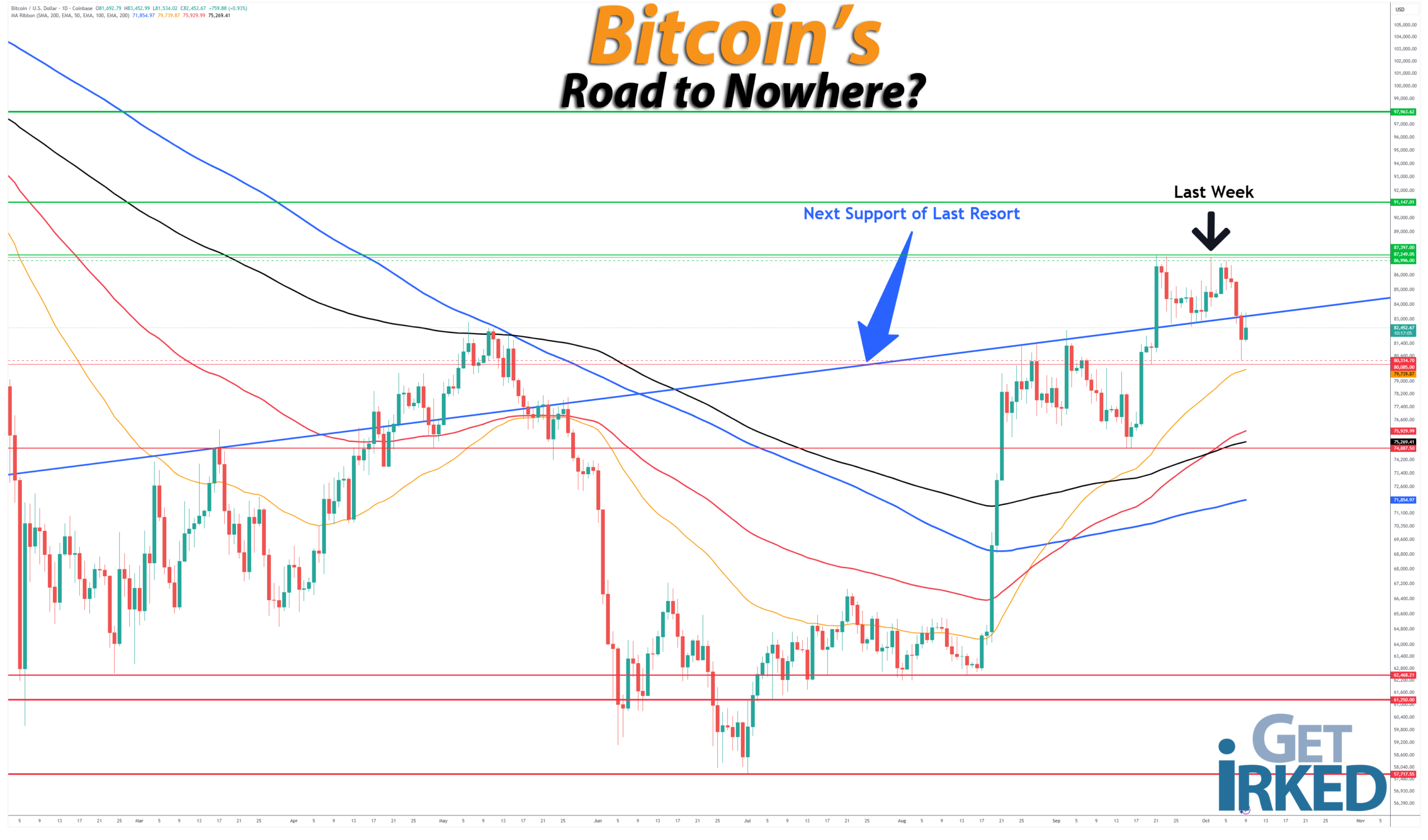
Bitcoin was unable to make a new high over the past week, just barely missing the opportunity to do so by finding resistance at $86,996.00 on Monday. Bitcoin then rolled over and broke down to a lower weekly-low on Thursday, not finding support until $80,314.70, narrowly missing the key support level at $80,08.00 from a few weeks ago. As a result, Bitcoin has flipped my long-term trendline, the Next Support of Last Resort (in blue on my chart), from support into resistance. Now, Bitcoin has to once again deal with the resistance presented by the trendline with bulls hoping it will be able to flip it once more.
This price action isn’t inherently bullish or bearish; it’s simply an indication of further consolidation. However, speaking of consolidation, I keep reading permabulls arguing that consolidation is what happens before continuation of a move, therefore Bitcoin is headed higher after this consolidation.
This is patently false.
Consolidation is neither bullish nor bearish. Consolidation is simply the market digesting the most recent move before it decides where to go from here.
How do I know?
Forget about the fact this is a simple known market dynamic of how consolidation works, let’s look at Bitcoin’s huge consolidation which took place from June 3 to August 17.
According to the permabull logic above, that consolidation should have led to a continuation of the prior move. But, you’ll remember the permabulls weren’t screaming about consolidation leading to further action in August because the continuation of the prior move would have been Bitcoin crashing lower, not rallying higher. The permabulls only point to consolidation meaning continuation when it benefits them, not when it works against their desired outcome.
This hypocrisy highlights why it’s so important for us, as investors, to follow both bulls and bears. We need to be able to see through biased and inaccurate justifications made to support their own narrative so we can get an impartial and objective view on the market or the asset we’re tracking.
For the bulls, Bitcoin remains in The Danger Zone. While I do remain cautiously optimistic about its price action, Bitcoin needs to break out higher soon - preferably over $90K - to get out of the current range.
Why is the current range “The Danger Zone?”
The current trading range mirrors 2018’s nearly perfectly - simply add a zero to the prices: in 2018, Bitcoin rallied from $5,400 to $8,500 before crashing to $3,130. That’s the identical percentage move as Bitcoin rallying from $54,000 to $85,000 before crashing to $31,300.
What does this mean for Bitcoin in 2026?
Bitcoin has rallied from $57,700 to $87,397.00. Bears argue that it’s still very possible Bitcoin could crash from here into the $30K-$40K region.
On the flip side, Bulls argue if Bitcoin can break out above its current $87,397.00 rally high, the new Bull Market may truly be on.
As for me, I have been adding to my position at the current levels so I am cautiously optimistic the Bull Market may be on, but I am also tempering my enthusiasm by buying in small quantities when I do add.
Each week is proving to be more exciting than the last!
Bitcoin Trade Update
Premium subscribers to Get Irked get access to all the moves I've made in my Bitcoin trade over the past week as well as my next thirty (30) ... yes, 30 ... buys in Bitcoin including price levels, quantities, and a full layout of my ongoing long-term trade in the world's biggest crypto.
Not Your Keys, Not Your Crypto...
In light of brokerage failures in 2022, I no longer keep any of my crypto on an exchange and I only keep enough USD on the exchanges I use to execute my next few buys. I use multiple cold wallets from the brands Ledger and Trezor to hold my crypto (click the links to access the direct sites, and I receive no affiliate benefits from these links).
No price target is unrealistic in the cryptocurrency space – Bullish or Bearish.
While traditional stock market investors and traders may think the price targets in the cryptocurrency space are outlandish due to the incredible spread (possible moves include drops of -90% or more and gains of +1000% or more), Bitcoin has demonstrated that, more than any speculative asset, its price is capable of doing anything.
Here are some of Bitcoin's price movements over the past couple of years:
- In 2017, Bitcoin rose +2,707% from its January low of $734.64 to make an all-time high of $19,891.99 in December.
- Then, Bitcoin crashed nearly -85% from its high to a December 2018 low of $3128.89.
- In the first half of 2019, Bitcoin rallied +343% to $13,868.44.
- In December, Bitcoin crashed -54% to a low of $6430.00 in December 2019.
- In February 2020, Bitcoin rallied +64% to $10,522.51.
- In March , Bitcoin crashed nearly -63% to a low of $3858.00, mostly in 24 hours.
- Then, Bitcoin rallied +988% to a new all-time high of $41,986.37 in January 2021.
- Later in January 2021, Bitcoin dropped -32% to a low of $28,732.00.
- In February, Bitcoin rallied +103% to a new all-time high of $58,367.00.
- Later in February, Bitcoin dropped -26% to a low of $43,016.00.
- In April , Bitcoin rallied +51% to a new all-time high of $64,896.75.
- In June , Bitcoin crashed -56% to a low of $28,800.00.
- In November, Bitcoin rallied +140% to a new all-time high of $69,000.00.
- In November 2022, Bitcoin crashed -78% to a low of $15,460.00.
- In April 2023, Bitcoin rallied +101% to a high of $31,050.00.
- In June, Bitcoin dropped -20% to a low of $24,750.00
- In July, Bitcoin rallied +29% to a high of $31,862.21.
- In September, Bitcoin dropped -22% to a low of $24,900.00.
- In January 2024, Bitcoin rallied +97% to a high of $49,102.29.
- Later in January, Bitcoin dropped -22% to a low of $38,501.00.
- In March, Bitcoin rallied +92% to a new all-time high of $73,835.57.
- In August, Bitcoin dropped -33% to a low of $49,050.01.
- In January 2025, Bitcoin rallied +150% to a new all-time high of $109,358.01.
- In April, Bitcoin dropped -32% to a low of $74,420.69.
- In May, Bitcoin rallied +51% to a new all-time high of $112,000.00.
- In June, Bitcoin dropped -12% to a low of $98,247.01.
- In July, Bitcoin rallied +25% to a new all-time high of $123,231.07.
- In September, Bitcoin dropped -14% to a low of $107,250.00.
- In October, Bitcoin rallied +18% to a new all-time high of $126,296.00.
- In July 2026, Bitcoin dropped -54% to a low of $57,717.55.
Where will Bitcoin go from here? Truly, anything is possible…
What if Bitcoin’s headed to zero?
The only reason I speculate in the cryptocurrency space is I truly believe Bitcoin isn’t headed to zero.
I am prepared for that possibility, however, by knowing I could potentially lose all of the capital I’ve allocated to this speculative investment. Professional advisers recommend speculating with no more than 5% of an investor’s overall assets. Personally, I’ve allocated less than that to speculating in crypto.
I feel that anyone who doesn’t fully believe in the long-term viability of cryptocurrency would be better served not speculating in the space.
On a good day, this asset class isn’t suitable for those with weak stomachs. On volatile days, the sector can induce nausea in the most iron-willed speculator. If a speculator isn’t confident in the space, the moves will cause mistakes to be made.
DISCLAIMER: Anyone considering speculating in the crypto sector should only do so with funds they are prepared to lose completely. All interested individuals should consult a professional financial adviser to see if speculation is right for them. No Get Irked contributor is a financial professional of any kind.
Ways to give back to GetIrked:
Send me a tip via Stripe! Thank you!
Get free money by signing up for an account with my referral link for Schwab
Sign up for Gemini and we each get $10
Click this referral link to get the Brave Browser
If you use Brave, you can also use the Tip function to tip me in Basic Attention Token (BAT).
Suicide Hotline - You Are Not Alone
Studies show that economic recessions cause an increase in suicide, especially when combined with thoughts of loneliness and anxiety.
If you or someone you know are having thoughts of suicide or self-harm, please contact the National Suicide Prevention Lifeline by visiting www.suicidepreventionlifeline.org or calling 1-800-273-TALK.
The hotline is open 24 hours a day, 7 days a week.

You must be logged in to post a comment.