
Summing Up The Week
The stock market didn’t ease into the week; stocks whipsawed as geopolitical theatrics, labor-market curveballs, and oil‑route brinkmanship collided into one of the most chaotic stretches investors have seen all summer.
Trump’s abrupt cancellation of a planned strike on Iran framed as a breakthrough on the “perimeters of a deal” barely nudged crypto, but it lit a fuse under equities once Treasury Secretary Scott Bessent stepped in days later to reassure Wall Street that a Strait of Hormuz agreement might actually materialize.
From there, the markets seemed determined to rally through anything: a soft ADP print, a draft Iranian plan to toll U.S. and Israeli ships, even a shock Labor Department report showing payrolls fell in July.
In a week where headlines contradicted each other as fast as officials could give interviews, investors chose a single narrative: bad news is good news, and any hint of de-escalation is fuel for the fire.
Let's take a deeper dive into the news that moved markets this week...
Market News
Trump cancels attack, claims "perimeters of a deal"
On Sunday, President Donald Trump canceled a planned attack on Iran saying that an agreement had been reached regarding the "perimeters of a deal," reported CNBC.
Trump announced the deal in a post on TruthSocial, "We have just been asked by Iran, and other Middle Eastern Countries, to hold off any attack in that the perimeters of a deal has been agreed to [that would include the] immediate, Complete, and Total OPENING OF THE HORMUZ STRAIT, and an end to Iran’s nuclear threat." Trump went on, "Based on this request, I have agreed, for the future benefit of the WORLD and, likewise, the survival of a successful and prosperous Iran, to cancel the attack, subject to being able to rapidly make a DEAL."
Iran didn't appear to have much faith in a deal actually coming together in a post on X, "Although the enemy’s recent statements are part of a psychological and cognitive warfare campaign, we consider every threat to be real and take it seriously."
With the markets closed over the weekend, I looked to the crypto market for a reaction, of which there wasn't much. Bitcoin weakened on Saturday dipping into the low $62K region and, while it did bounce from there, the bounce was anemic with Bitcoin barely making it above $63K and showing little to no reaction following Trump's announcement.
Bessent affirms there may be a deal Tuesday or Wednesday
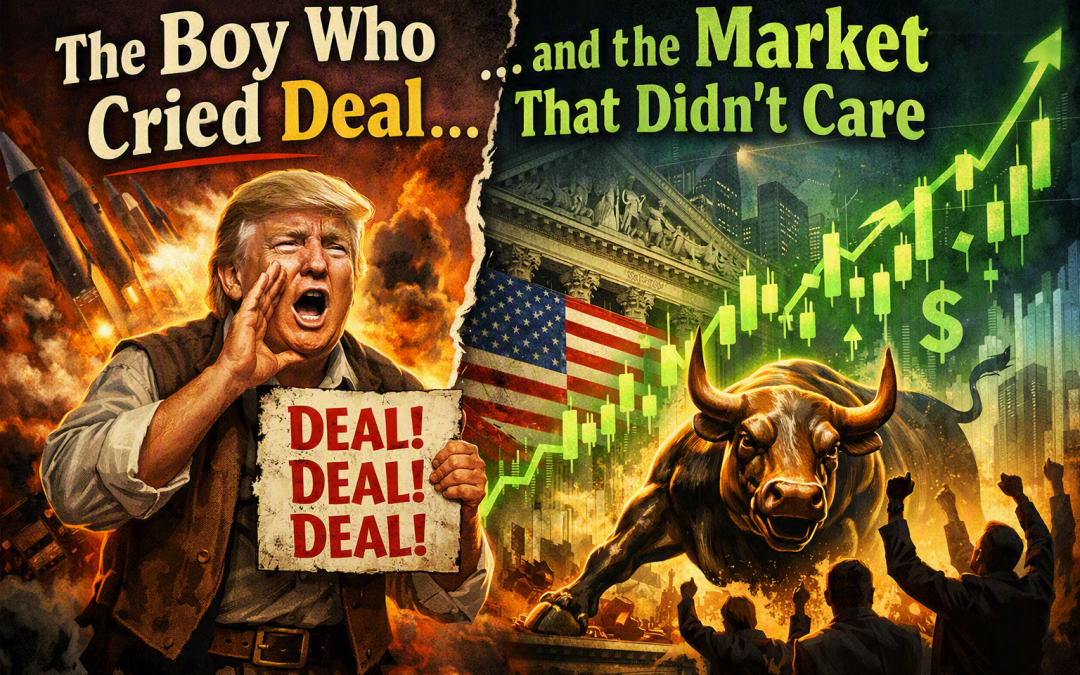
On Tuesday morning, Treasury Secretary Scott Bessent said the United States and Iran were working toward a deal to reopen the Strait of Hormuz on Tuesday or Wednesday in an interview with CNBC. While the more cynical among us may say the Trump Administration feared the President had become the proverbial Boy Who Cried Deal by repeatedly claiming a deal existed when none materialized and, thus, necessitated the rollout of a more trustworthy face, the markets certainly didn't mind and added on to Monday's spectacular gains.
"We are in talks with the Iranians," Bessent said in an interview with CNBC’s Squawk Box on Tuesday. "There is a chance we may have a deal today or tomorrow to open the strait and move towards a more normalized position in this conflict."
Bessent went on to tout how many sectors would see extreme relief in the event of the reopening of the strait, "It’s not just energy. It’s fertilizer, it’s refined products, it is the various industrial gasses; we could see a big relief trade as those prices go down."
Private companies added 44K jobs in July, below expectations
On Wednesday, private payroll processor ADP reported that companies added 44,000 jobs in July, far below the Dow estimate of 75,000 new jobs for the month, reported CNBC. All of the gains came from service-sector jobs which added 47,000 while manufacturing jobs decreased 3,000.
Pay gains held steady at 4.4% annually for those staying in their jobs. However, job switchers saw a 7% increase, the largest since August 2025. "Job-changers are highly sensitive to real-time economic conditions, and their rapid pay growth implies supply constraints in parts of the labor market," said ADP Chief Economist Nela Richardson. "Typical hiring patterns, meanwhile, are changing as employers react to shifting macroeconomic conditions."
The markets, which had been rallying going into the news, completely ignored the mediocre jobs report and continued higher. The continuing rally could also have been built on the fact that the ADP report is often the direct opposite of the Labor Department's own numbers which wouldn't be released until Friday.
Iran releases plan to block U.S. & Israeli ships from Strait of Hormuz
On Thursday, Iran released the draft of a plan with Oman to block U.S. and Israeli ships from passage through the Strait of Hormuz while allowing other countries' ships to pass with tolls, reported CNBC. The plan came after President Trump and Treasury Secretary Bessent claimed a deal between the U.S. and Iran would be struck by Wednesday which came and passed with no plan at all.
The U.S. immediately rejected the Iranian terms. "Any temporary routes will be without any impediments meaning no approvals or permissions and no tolls or charges," a U.S. official told CNBC when asked about the Fars report. "The Strait of Hormuz is an international waterway and no party controls the lanes or the ability to transit through them."
The Iranian plans includes penalties of up to 20% of the value of the cargo for any ship violating the terms of the agreement and would also charge a 7% toll on any ship seeking passage through the strait. Additionally, Iranian Deputy Foreign Minister Kazem Gharibabadi said the U.S. was ready to "return to commitments" while denying that U.S. negotiations were ongoing with Tehran in an interview with state broadcasting service IRNA on Wednesday evening.
The price of oil rose following the news release and while stocks closed down with the S&P 500 and Nasdaq finishing the day -0.18% and -0.06%, respectively, the rollover in stocks was likely just an ongoing pause following the spectacular rally stocks saw earlier in the week on Monday and Tuesday.
U.S. payrolls lost 23,000 jobs in July, defying expectations
On Friday, the Labor Department's payroll report for July showed a loss of 23,000 jobs in July against expectations for a gain of 83,000 while the unemployment rate fell slightly to 4.1%, reported CNBC. Stocks rallied on Friday on the back of the report which, while counterintuitive at first, makes sense when you realize investors are excited this weak report might mean the Federal Reserve won't raise interest rates at their September meeting.
The drop in jobs was led by a 50,000 decline in local government education and a loss of 19,000 retail jobs. Financial activities also posted a fall of 14,000 and leisure and hospitality lost 40,000, which CNBC attributed to the World Cup tournament ending. "The July employment report solidified that the labor market is not out of the woods quite yet," said Nicole Bachaud, Labor Economist at ZipRecruiter.
Next Week's Gameplan
It's time for inflation data next week with the release of the Consumer Price Index (CPI) on Wednesday followed by the Producer Price Index (PPI) on Thursday. We'll also see some other interesting datapoints such as existing home sales on Tuesday and retail sales on Friday, but the big ones will be those inflation reports.
As for earnings, here are my positions reporting next week that I'll be keeping a close eye on:
Monday: Barrick Gold (B) reports Before Market Open (BMO). Rocket Labs (RKLB) reports After Market Close (AMC).
Tuesday: GrowGeneration (GRWG) reports AMC.
Wednesday: Virgin Galactic (SPCE) reports AMC.
Thursday: Intuitive Machines (LUNR) reports BMO. Brookfield (BN), DeFi Technologies (DEFT), and Yeti Brands (YETI) report AMC.
With still no signs of a peace deal with Iran, expect a lot more volatility to swing into the market during the "dog days of summer" as low trading volume can lead to big moves in individual stocks and the indexes themselves.
Then, join me here next Friday to go over all the moves and what to expect going forward, friends!
Check out Get Irked Premium on Substack!
After providing FREE content since 2018, the time constraints of producing Investments in Play, Speculation in Play, the Pandemic Portfolio, and Stock Shopping List have become too much to continue doing for free.
On Substack, you can subscribe for FREE to have the Week in Review and Crypto Corner, now separate newsletters, sent to your email inbox at no cost. The portfolio updates and Stock Shopping List are now part of a premium subscription plan.
I hope you will join me on Substack as I continue on this exciting journey!
THANK YOU FOR YOUR ONGOING SUPPORT!
Crytpo Corner
Click chart for enlarged version
Bitcoin Price (in USD)
%
Weekly Change
Bitcoin Price Action
Bitcoin remains a noncorrelated asset… unless it’s to the downside. When President Donald Trump announced a deal was in the works with Iran on Monday followed by Treasury Secretary Scott Bessent reinforcing the thesis on Tuesday, the S&P 500 and Nasdaq each shot up more than 2%.
Bitcoin… did nothing.
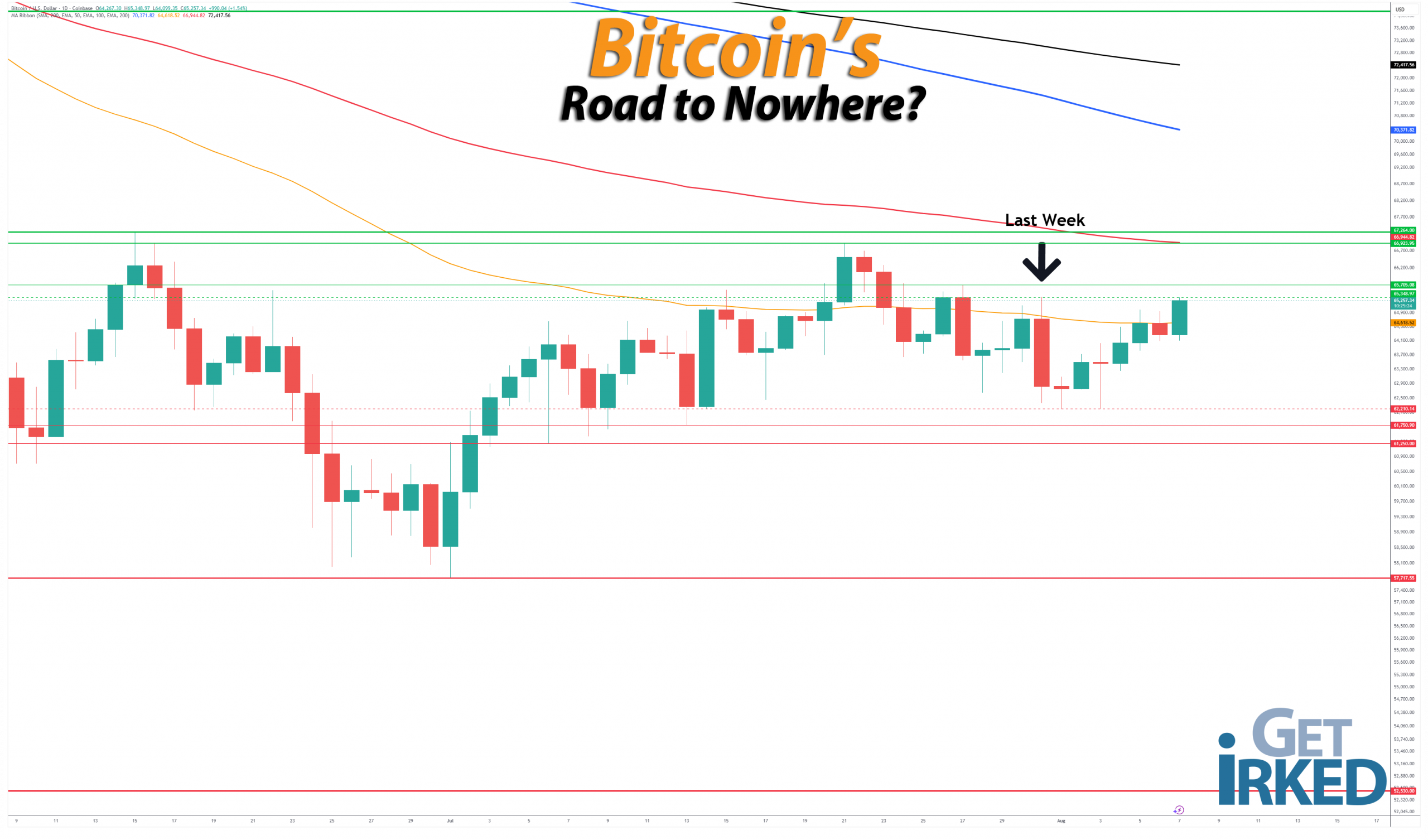
In fact, Bitcoin did worse than nothing - it actually broke below last week’s low in the middle of the positive news cycle on Monday, not finding support until $62,210.14. When Bitcoin did manage to rally with the rest of the market, it wasn’t even able to test the weekly high at $65,705.08, instead finding resistance at $65,348.97 on Friday.
And, yet, the Bulls continue to extol why the bottom is in and how the passage of the CLARITY Act will be the catalyst that Bitcoin needs to take it to all-time highs. While the CLARITY Act will open up a lot of the space with the regulation it needs, there’s an important fact the Bulls leave out:
Every single regulation or product launch in Bitcoin’s entire history has been a sell-the-news event.
All of them.
In other words, regardless of whether or not Bitcoin rallied into the launch of futures, the launch of the Grayscale Bitcoin Trust, or even the launch of the Bitcoin ETFs, the entire crypto space has always sold off following a new supposedly-bullish catalyst.
When the ETFs launched on January 11, 2024 - arguably considered the most bullish catalyst for the entire space - Bitcoin rallied to a high of $49,050.01 only to roll over and sell off more than -21.50% in less than twelve (12) trading days to a low of $38,501.00 on January 23.
While the ETF-launch selloff proved to be an excellent buying opportunity (and I did add to my positions in significant quantities under $40K), that price action is a warning that investors should be extremely careful heading into any “positive catalyst.” History dictates the wise investor doesn’t try to front news but, rather, waits until the price action following the event to add to positions.
Over the long term, I remain Bullish on Bitcoin, of course, but until Bitcoin flushes out to the downside or makes some serious upside progress to $80K or higher, I am continuing to sit on the sidelines and watch as the Bear thesis remains intact:
This Crypto Winter is unlikely over with a much lower-low in store somewhere within the next six months.
Rest assured, I am always open-minded, so I’m constantly looking for data and statistics to disprove the Bear Case. If I find anything, my readers will be the first to know.
Bitcoin Trade Update
Premium subscribers to Get Irked get access to all the moves I've made in my Bitcoin trade over the past week as well as my next thirty (30) ... yes, 30 ... buys in Bitcoin including price levels, quantities, and a full layout of my ongoing long-term trade in the world's biggest crypto.
Not Your Keys, Not Your Crypto...
In light of brokerage failures in 2022, I no longer keep any of my crypto on an exchange and I only keep enough USD on the exchanges I use to execute my next few buys. I use multiple cold wallets from the brands Ledger and Trezor to hold my crypto (click the links to access the direct sites, and I receive no affiliate benefits from these links).
No price target is unrealistic in the cryptocurrency space – Bullish or Bearish.
While traditional stock market investors and traders may think the price targets in the cryptocurrency space are outlandish due to the incredible spread (possible moves include drops of -90% or more and gains of +1000% or more), Bitcoin has demonstrated that, more than any speculative asset, its price is capable of doing anything.
Here are some of Bitcoin's price movements over the past couple of years:
- In 2017, Bitcoin rose +2,707% from its January low of $734.64 to make an all-time high of $19,891.99 in December.
- Then, Bitcoin crashed nearly -85% from its high to a December 2018 low of $3128.89.
- In the first half of 2019, Bitcoin rallied +343% to $13,868.44.
- In December, Bitcoin crashed -54% to a low of $6430.00 in December 2019.
- In February 2020, Bitcoin rallied +64% to $10,522.51.
- In March , Bitcoin crashed nearly -63% to a low of $3858.00, mostly in 24 hours.
- Then, Bitcoin rallied +988% to a new all-time high of $41,986.37 in January 2021.
- Later in January 2021, Bitcoin dropped -32% to a low of $28,732.00.
- In February, Bitcoin rallied +103% to a new all-time high of $58,367.00.
- Later in February, Bitcoin dropped -26% to a low of $43,016.00.
- In April , Bitcoin rallied +51% to a new all-time high of $64,896.75.
- In June , Bitcoin crashed -56% to a low of $28,800.00.
- In November, Bitcoin rallied +140% to a new all-time high of $69,000.00.
- In November 2022, Bitcoin crashed -78% to a low of $15,460.00.
- In April 2023, Bitcoin rallied +101% to a high of $31,050.00.
- In June, Bitcoin dropped -20% to a low of $24,750.00
- In July, Bitcoin rallied +29% to a high of $31,862.21.
- In September, Bitcoin dropped -22% to a low of $24,900.00.
- In January 2024, Bitcoin rallied +97% to a high of $49,102.29.
- Later in January, Bitcoin dropped -22% to a low of $38,501.00.
- In March, Bitcoin rallied +92% to a new all-time high of $73,835.57.
- In August, Bitcoin dropped -33% to a low of $49,050.01.
- In January 2025, Bitcoin rallied +150% to a new all-time high of $109,358.01.
- In April, Bitcoin dropped -32% to a low of $74,420.69.
- In May, Bitcoin rallied +51% to a new all-time high of $112,000.00.
- In June, Bitcoin dropped -12% to a low of $98,247.01.
- In July, Bitcoin rallied +25% to a new all-time high of $123,231.07.
- In September, Bitcoin dropped -14% to a low of $107,250.00.
- In October, Bitcoin rallied +18% to a new all-time high of $126,296.00.
- In July 2026, Bitcoin dropped -54% to a low of $57,717.55.
Where will Bitcoin go from here? Truly, anything is possible…
What if Bitcoin’s headed to zero?
The only reason I speculate in the cryptocurrency space is I truly believe Bitcoin isn’t headed to zero.
I am prepared for that possibility, however, by knowing I could potentially lose all of the capital I’ve allocated to this speculative investment. Professional advisers recommend speculating with no more than 5% of an investor’s overall assets. Personally, I’ve allocated less than that to speculating in crypto.
I feel that anyone who doesn’t fully believe in the long-term viability of cryptocurrency would be better served not speculating in the space.
On a good day, this asset class isn’t suitable for those with weak stomachs. On volatile days, the sector can induce nausea in the most iron-willed speculator. If a speculator isn’t confident in the space, the moves will cause mistakes to be made.
DISCLAIMER: Anyone considering speculating in the crypto sector should only do so with funds they are prepared to lose completely. All interested individuals should consult a professional financial adviser to see if speculation is right for them. No Get Irked contributor is a financial professional of any kind.
Ways to give back to GetIrked:
Send me a tip via Stripe! Thank you!
Get free money by signing up for an account with my referral link for Schwab
Sign up for Gemini and we each get $10
Click this referral link to get the Brave Browser
If you use Brave, you can also use the Tip function to tip me in Basic Attention Token (BAT).
Suicide Hotline - You Are Not Alone
Studies show that economic recessions cause an increase in suicide, especially when combined with thoughts of loneliness and anxiety.
If you or someone you know are having thoughts of suicide or self-harm, please contact the National Suicide Prevention Lifeline by visiting www.suicidepreventionlifeline.org or calling 1-800-273-TALK.
The hotline is open 24 hours a day, 7 days a week.

You must be logged in to post a comment.