
Summing Up The Week
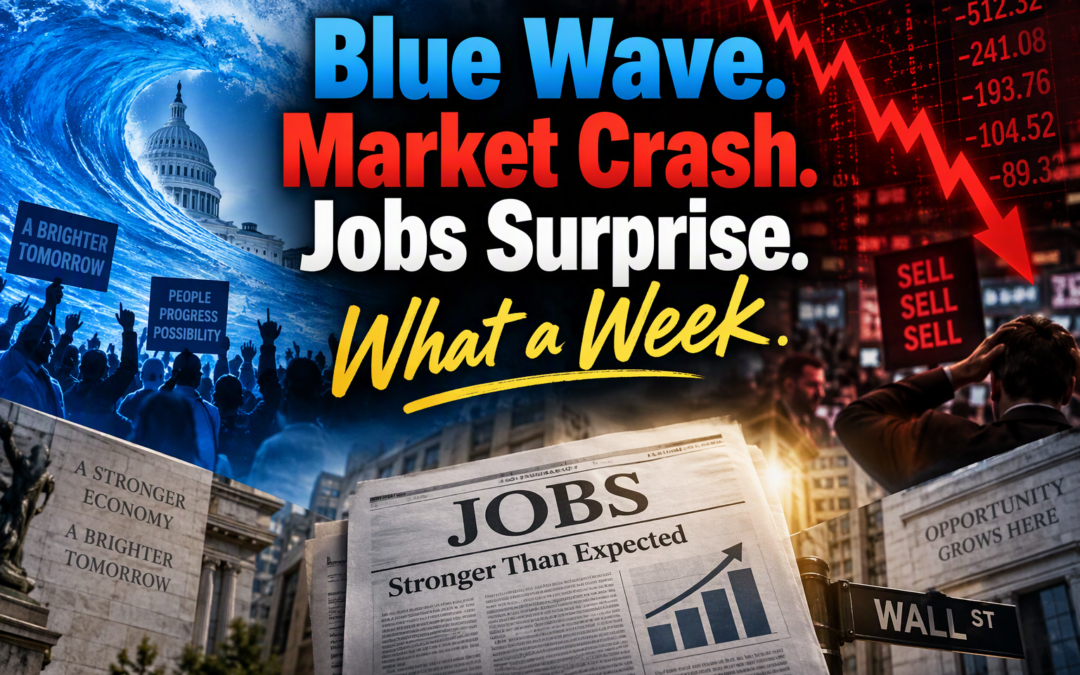
The market spent the week doing what it does best: confounding everyone.
Investors woke up on Wednesday celebrating a surprising Democratic sweep in the midterm elections, only to watch that optimism evaporate a day later in one of the sharpest selloffs of the year on Thursday.
By Friday, a much stronger-than-expected jobs report had traders reversing course once again, proving that in today's market, conviction can be measured in hours rather than weeks.
Beneath the headline volatility, investors are wrestling with several major questions at once. How will a dramatically altered political landscape affect economic policy, corporate profitability, and the future of AI-driven spending? Is the recent weakness in technology stocks merely a healthy correction, or the beginning of something more significant? And with the labor market continuing to show surprising resilience, what does that mean for growth expectations heading into year-end?
This week featured all the ingredients of a modern market drama: election surprises, violent sector rotations, a near-correction in the Nasdaq, and economic data that challenged prevailing narratives.
Let's break down the stories that moved markets and what they could mean for investors going forward...
Market News
Democrat "Blue Wave" Sweeps Midterms
Tuesday's midterm elections showed U.S. citizens want a change from compounding inflation, rising gas prices, increased cost of living, and a war with Iran as Democrats resoundingly beat Republicans in many areas where Trump had easily won in 2024, reported CNBC.
Many Democrats attributed their wins to a populace tired of seeing the rich benefit while the middle class pays the bills, "Tonight’s results are a wake-up call for corporate special interests and billionaires who have been rigging the economy," said Rep. Chris Pappas to CNBC, who defeated former Republican Sen. John Sununu to win an open Senate seat in New Hampshire.
CNBC believes that the Democrats effectively tied corruption to affordability with many focusing on almost-obvious grifts being practiced by those in power to benefit billionaires and their cronies. "We must get big money out of our politics, so no billionaire or trillionaire can buy our elections. We must unrig this economic system that only benefits the top one percent," said James Talarico who became the first Democrat elected from Texas in almost forty years. "The real fight in this country is not left versus right. It is top versus bottom."
Further, CNBC pointed to Trump's "vengeance tour" to having the opposite effect as intended as Trump's attempts to promote certain candidates ended up only galvanizing the opposition with Democrats winning Texas, South Carolina, North Carolina, and, at the time of writing, even Michigan - areas where Trump campaigned hard for Republican candidates.
While initially the stock market futures sold off on the back of an assumed stay in data center spending with the S&P 500 down more than -1.25% and the Nasdaq down -2% during Election Night, both indexes rebounded before the market opened Wednesday, up nearly 1% and 0.5%, respectively. This flip-flop was likely due to the market realizing government deadlock is typically good for markets as nothing unexpected or surprising will come from Washington D.C. since neither party will agree on anything.
Stock market enters freefall
On Thursday, the stock market went into freefall erasing all of the gains of Wednesday's relief rally and then some with the Nasdaq declining nearly -6% intraday and entering correction territory, reported CNBC.
Despite no news catalyst explaining the price action, analysts tried to come up with an explanation by suggesting investors are rotating out of growth plays, "[They're] stepping away until they get a better sense of the implications of the midterms around the AI capex cycle in particular, which is the biggest economic tailwind we’ve had going for us for the last, call it, three years," said Tim Holland, Chief Investment Officer at Orion in an interview with CNBC. "It’s about tone and tenor from the party that did really well, incredibly well, at the federal level and at the state level."
U.S. added 165K jobs in October, significantly more than expected
On Friday, the U.S. payroll report showed the economy added 165,000 jobs in October, a significant surprise over the mere 59,000 expected by Dow Jones economists, reported CNBC. Additionally, the unemployment rate dipped 0.1% to 4.1% compared to a forecast for 4.2%.
With numbers coming in better than expected, analysts expect no weakening in the economy in the near term, at least. "Today’s jobs report is a strong rebuttal to fears that the economy is heading into a meaningful slowdown," said Seema Shah, Chief Global Strategist at Principal Asset Management. "Payrolls growth surprised firmly to the upside, unemployment fell back to 4.1%, and job creation remains broad-based, pointing to an economy that is still absorbing labor comfortably rather than one beginning to buckle under tighter financial conditions."
After Thursday's incredible selloff, it came as no surprise when all of the indexes opened in the green following the jobs report on Friday morning.
Next Week's Gameplan
Next week promises to be another big one as we'll get the Consumer Price Index review of inflation on Tuesday followed by the Producer Price Index (PPI) on Friday. Additionally, there will be some Fed speak as several FOMC members have speeches, and we'll also see the state of existing home sales on Thursday.
Additionally, there are plenty of earnings reports I'll be watching:
Monday: Barrick Gold (B) reports Before Market Open (BMO). Equinox Gold (EQX), Rocket Lab (RKLB), Take Two Interactive (TTWO), and USA Rare Earth (USAR) report After Market Close (AMC).
Tuesday: GrowGeneration (GRWG) reports AMC.
Thursday: Brookfield (BN), Intuitive Machines (LUNR), Virgin Galactic (SPCE), and Yeti Brands (YETI) report BMO.
Combine the erratic and volatile nature of the markets lately, and you've got a recipe for what could be a spicy week so be sure to join me back here next Friday as we go over all the week's details, friends!
Check out Get Irked Premium on Substack!
After providing FREE content since 2018, the time constraints of producing Investments in Play, Speculation in Play, the Pandemic Portfolio, and Stock Shopping List have become too much to continue doing for free.
On Substack, you can subscribe for FREE to have the Week in Review and Crypto Corner, now separate newsletters, sent to your email inbox at no cost. The portfolio updates and Stock Shopping List are now part of a premium subscription plan.
I hope you will join me on Substack as I continue on this exciting journey!
THANK YOU FOR YOUR ONGOING SUPPORT!
Crytpo Corner
Click chart for enlarged version
Bitcoin Price (in USD)
%
Weekly Change
Bitcoin Price Action
I remain baffled by the permabulls.
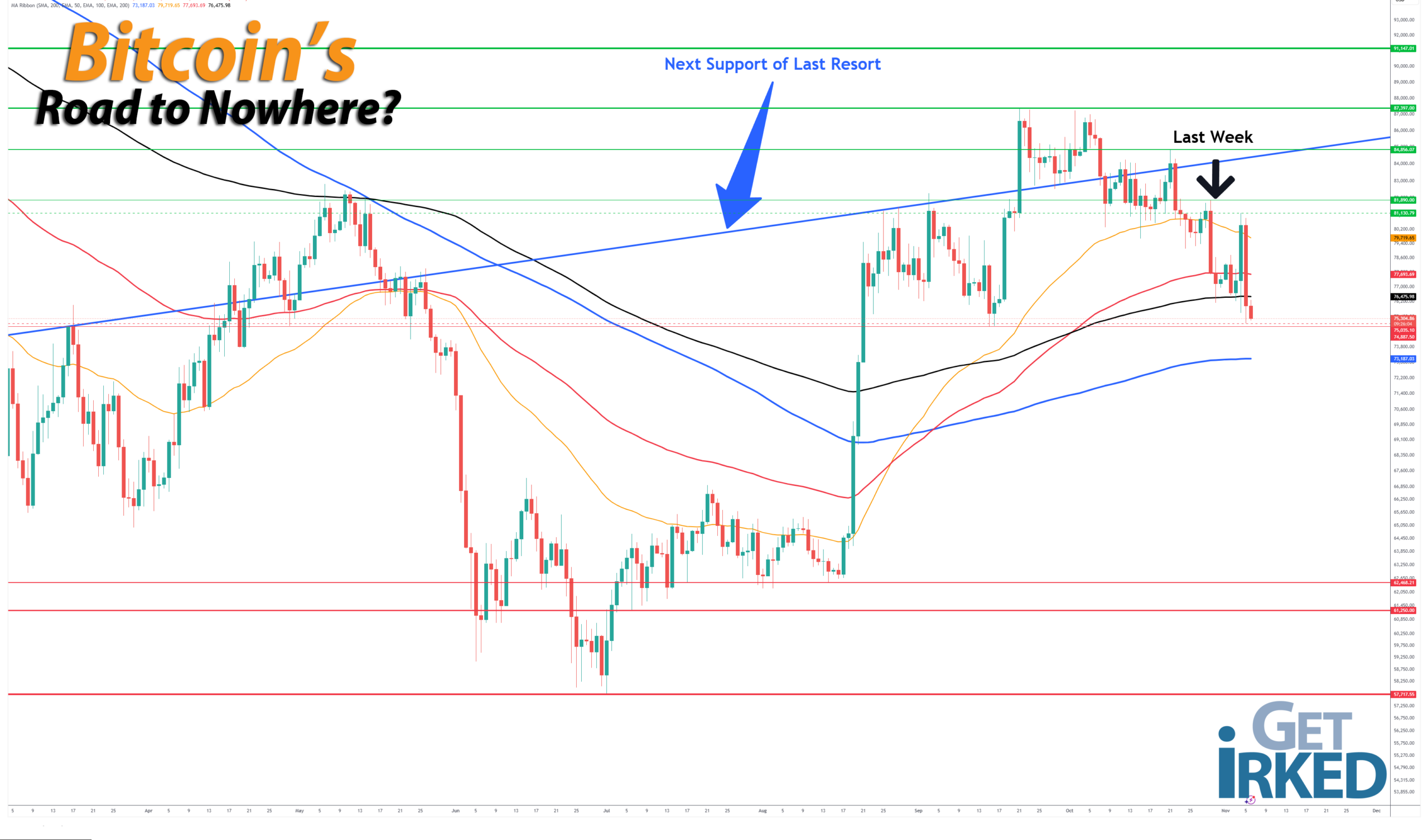
After Bitcoin made a meek lower weekly-high at $81,130.79 on Wednesday, it crashed through key support on Thursday only to eventually create a new weak support level at $75,035.10. Meanwhile, permabulls posted everywhere on X that Bitcoin looked good on the long timeframe after Bitcoin broke a higher support level on Tuesday evening that signified further downside.
Wait. What?
Never ignore when a major asset breaks through key support, even if it recovers, particularly when Bitcoin does it. For the near-decade I’ve been involved in the Big Orange Crypto, I’ve pointed out how Bitcoin sends these “warning flares” where it breaks low and everyone ignores the brief wick with excuses like “it was on weak volume” or a “fast reversal indicates Bulls are buying.”
The reality is starkly different. Historically, whenever Bitcoin sends one of these warning flares, that’s the crypto telling us where it plans to go. And, in this case, that sign is lower.
There is nothing bullish in Bitcoin right now:
-
The Democrats taking a majority in both the House and the Senate means the Clarity Act is cooked.
-
Macropolitical events are seriously negative for all risk assets (including Bitcoin) with a war in Ukraine that might heat up and a war in Iran that’s nowhere near done.
-
Plus, we’re in the middle of the most dangerous time both in seasonality but also by the calendar for Bitcoin (see below).
None of this is bullish.
Let’s go over my Crypto Winter Crash cheatsheet again for the cheap seats in the back (or for those of you who are new here).
- Whenever there’s a Crypto Winter, it follows these steps:
- Bitcoin crashes 55% or more from the most recent all-time high.
- Bitcoin rallies 50-60%+ from that low.
- Permabulls scream “This time is different! The bottom is in!”
- New money pours into the space.
- Bitcoin rolls over and crashes 50%+ lower than “the bottom.”
But, let’s say you still think the bottom is in.
Alright.
Try this on for size:
-
When did Bitcoin start its final descent in 2022? November 8.
-
When did Bitcoin start its final descent in 2018? November 14.
-
What day is it today? November 6.
In the past two Crypto Winters, Bitcoin started its final descent within the first two weeks of November… almost to the exact same day.
“Professionals” will tell you to ignore the calendar and claim that seasonality doesn’t matter. That’s fine, but I predicted 2022’s crash in October 2022 - weeks before it happened - simply by looking at 2018’s price action, seeing similarities, and warning people on Twitter about my findings.
Let’s say you still think the bottom is in.
Fine.
So far in this Crypto Winter, Bitcoin has crashed only -54.25% from its all-time high.
The next closest drop is 2022’s Crypto Winter when Bitcoin crashed -77.57% from its all-time high, a difference of more than -40%.
Going further back:
-
In 2018’s Crypto Winter, Bitcoin crashed -84.36%.
-
In 2014’s Crypto Winter, Bitcoin crashed -86.96%.
As someone with a master’s degree in statistical analysis, a -54.25% is so incredibly improbable that it’s painfully unlikely Bitcoin’s made its final low for this Crypto Winter.
Even the most optimistic statistical predictions suggest we should expect a selloff of at least -70% from the all-time high (8% less than 2022’s Crypto Winter which was 8% less than 2018’s Crypto Winter).
A -70% crash from our current ATH gives us a price target right around $38,000.
Okay.
Long-time readers of my blog know that I’m not selling everything and going to cash, not even close.
Instead, I’m holding what I have in my trade already and adding at key levels on the way down, increasing my quantities along the way.
I’m in this for the long term. Over the long term, I’m uber bullish. But, over the short term… well…
Bitcoin is unpredictable.
Bitcoin is volatile.
Bitcoin is the essence of wealth destruction.
… but only if you sell.
If you believe in Bitcoin, you have two choices when it crashes: add -or- HODL.
Never sell.
However, just like with any asset, there’s always the possibility of Bitcoin going completely to zero (no matter how unlikely). As a result, I manage my risk by knowing the entire amount I’m willing to lose entirely. That’s right - I know right now how much I will lose if Bitcoin goes to zero.
The game is investing.
The rules are risk management.
The way to win is having a plan.
Bitcoin Trade Update
Premium subscribers to Get Irked get access to all the moves I've made in my Bitcoin trade over the past week as well as my next thirty (30) ... yes, 30 ... buys in Bitcoin including price levels, quantities, and a full layout of my ongoing long-term trade in the world's biggest crypto.
Not Your Keys, Not Your Crypto...
In light of brokerage failures in 2022, I no longer keep any of my crypto on an exchange and I only keep enough USD on the exchanges I use to execute my next few buys. I use multiple cold wallets from the brands Ledger and Trezor to hold my crypto (click the links to access the direct sites, and I receive no affiliate benefits from these links).
No price target is unrealistic in the cryptocurrency space – Bullish or Bearish.
While traditional stock market investors and traders may think the price targets in the cryptocurrency space are outlandish due to the incredible spread (possible moves include drops of -90% or more and gains of +1000% or more), Bitcoin has demonstrated that, more than any speculative asset, its price is capable of doing anything.
Here are some of Bitcoin's price movements over the past couple of years:
- In 2017, Bitcoin rose +2,707% from its January low of $734.64 to make an all-time high of $19,891.99 in December.
- Then, Bitcoin crashed nearly -85% from its high to a December 2018 low of $3128.89.
- In the first half of 2019, Bitcoin rallied +343% to $13,868.44.
- In December, Bitcoin crashed -54% to a low of $6430.00 in December 2019.
- In February 2020, Bitcoin rallied +64% to $10,522.51.
- In March , Bitcoin crashed nearly -63% to a low of $3858.00, mostly in 24 hours.
- Then, Bitcoin rallied +988% to a new all-time high of $41,986.37 in January 2021.
- Later in January 2021, Bitcoin dropped -32% to a low of $28,732.00.
- In February, Bitcoin rallied +103% to a new all-time high of $58,367.00.
- Later in February, Bitcoin dropped -26% to a low of $43,016.00.
- In April , Bitcoin rallied +51% to a new all-time high of $64,896.75.
- In June , Bitcoin crashed -56% to a low of $28,800.00.
- In November, Bitcoin rallied +140% to a new all-time high of $69,000.00.
- In November 2022, Bitcoin crashed -78% to a low of $15,460.00.
- In April 2023, Bitcoin rallied +101% to a high of $31,050.00.
- In June, Bitcoin dropped -20% to a low of $24,750.00
- In July, Bitcoin rallied +29% to a high of $31,862.21.
- In September, Bitcoin dropped -22% to a low of $24,900.00.
- In January 2024, Bitcoin rallied +97% to a high of $49,102.29.
- Later in January, Bitcoin dropped -22% to a low of $38,501.00.
- In March, Bitcoin rallied +92% to a new all-time high of $73,835.57.
- In August, Bitcoin dropped -33% to a low of $49,050.01.
- In January 2025, Bitcoin rallied +150% to a new all-time high of $109,358.01.
- In April, Bitcoin dropped -32% to a low of $74,420.69.
- In May, Bitcoin rallied +51% to a new all-time high of $112,000.00.
- In June, Bitcoin dropped -12% to a low of $98,247.01.
- In July, Bitcoin rallied +25% to a new all-time high of $123,231.07.
- In September, Bitcoin dropped -14% to a low of $107,250.00.
- In October, Bitcoin rallied +18% to a new all-time high of $126,296.00.
- In July 2026, Bitcoin dropped -54% to a low of $57,717.55.
Where will Bitcoin go from here? Truly, anything is possible…
What if Bitcoin’s headed to zero?
The only reason I speculate in the cryptocurrency space is I truly believe Bitcoin isn’t headed to zero.
I am prepared for that possibility, however, by knowing I could potentially lose all of the capital I’ve allocated to this speculative investment. Professional advisers recommend speculating with no more than 5% of an investor’s overall assets. Personally, I’ve allocated less than that to speculating in crypto.
I feel that anyone who doesn’t fully believe in the long-term viability of cryptocurrency would be better served not speculating in the space.
On a good day, this asset class isn’t suitable for those with weak stomachs. On volatile days, the sector can induce nausea in the most iron-willed speculator. If a speculator isn’t confident in the space, the moves will cause mistakes to be made.
DISCLAIMER: Anyone considering speculating in the crypto sector should only do so with funds they are prepared to lose completely. All interested individuals should consult a professional financial adviser to see if speculation is right for them. No Get Irked contributor is a financial professional of any kind.
Ways to give back to GetIrked:
Send me a tip via Stripe! Thank you!
Get free money by signing up for an account with my referral link for Schwab
Sign up for Gemini and we each get $10
Click this referral link to get the Brave Browser
If you use Brave, you can also use the Tip function to tip me in Basic Attention Token (BAT).
Suicide Hotline - You Are Not Alone
Studies show that economic recessions cause an increase in suicide, especially when combined with thoughts of loneliness and anxiety.
If you or someone you know are having thoughts of suicide or self-harm, please contact the National Suicide Prevention Lifeline by visiting www.suicidepreventionlifeline.org or calling 1-800-273-TALK.
The hotline is open 24 hours a day, 7 days a week.

You must be logged in to post a comment.