

Summing Up The Week
With the U.S.-Iran War back on, you'd be forgiven to think that this week would have been particularly bad for markets. Instead, stocks didn’t just shake off the return of the U.S.–Iran War this week, they essentially laughed in its face. After last week’s flash‑selloff, investors came storming back like bargain‑hungry adrenaline junkies, scooping up every microscopic dip the market dared to offer.
Even as tanker attacks in the Strait of Hormuz triggered fresh U.S. strikes, sanctions whiplash, and a presidential “it’s over” declaration that sent volatility ripping through the indexes, the broader market refused to crack. Instead, it delivered a defiant rally that felt less like cautious optimism and more like traders collectively saying, “War? Rate confusion? Blockades? Cool story, bro. We’re buying anyway.”
Let's take a deep dive into the news that moved markets this week...
Market News
U.S. revokes Iran sanctions; resumes strikes after Hormuz Strait attacks
On Tuesday, the United States revoked the Iranian oil sales waiver and reinitiated strikes on Iran following a series of attacks on tankers traversing the Strait of Hormuz, reported CNBC (waiver revoking and strikes).
The revocation of oil sanctions came after a natural gas tanker, an oil VLCC (Very Large Crude Container), and a third unspecified tanker were attacked on Tuesday which increased the threat level of "severe" given that additional attacks were likely.
As a result, the U.S. Treasury Department reinstituted the prior sanctions against Irnaian oil sales. "Iran will only reap benefits if they exhibit good behavior," a U.S. official told CNBC. "Iran’s actions in the Strait were wholly unacceptable to the United States and will be met with consequences."
The S&P 500 took the news in stride, selling off less than -0.50% during Tuesday's trading, but the Nasdaq sold off -1.16%. Personally, I believe the discrepancy between the two indexes might have been SpaceX (SPCX) joining the Nasdaq-100 and index fund managers needing to sell other assets to make space for the mammoth stock.
Trump says ceasefire with Iran is "over"
On Wednesday morning, President Donald Trump said the U.S. ceasefire with Iran is over after Iranian attacks on tankers making passage through the Strait of Hormuz, reported CNBC. Trump made the comment "I think it's over" in response to a reporter's question about the ceasefire at a joint press conference with NATO Chief Mark Rutte in Ankara Turkey.
Trump went on to express additional frustrations with the Iranian negotiations, saying "I don’t want to deal with them anymore … as far as I’m concerned, it’s over," and continuing by saying that it's "a waste of time dealing with" Iran.
As a result, stocks plunged with the S&P down about -0.75% and the Nasdaq down -1.05%, compounding the losses from Tuesday's pullback.
Later on Wednesday, Trump continued to warn Iran saying that the U.S. would "very probably" attack Iran "hard again tonight," reported CNBC. "I’ll give him a little warning. We’re going to hit them hard tonight, but we’ll see how it all works out."
Trump added that the U.S. may reinstate its blockade of Iran's ports near the Strait of Hormuz, "We may put it back, the blockade, and it’ll only be a blockade for Iran."
Fed officials were split on direction of interest rates
On Wednesday, the minutes from the Federal Reserve's June meeting showed officials were split on which way to take interest rates next, reported CNBC. I would have been more concerned if the Fed was in total agreement with which way to take rates! With so much confusion regarding geopolitics and the price of energy combined with a seemingly strong labor market and economy, anyone who isn't second-guessing what the correct next move is for interest rates simply isn't paying attention.
In Kevin Warsh’s first meeting June 16-17 as chairman of the Federal Open Market Committee, participants saw outcomes where inflation could ease and allow lower rates, while others envisioned a scenario where price increases stay elevated and lead to hikes.
Asked to judge their most likely scenario, “many participants indicated that the appropriate level of the federal funds rate would be within or slightly below the current target range at the end of this year,” the minutes stated.
Naturally, with all of the back-and-forth going on between the U.S. and Iran reignited, it's of little surprise that the release of the June minutes had absolutely no effect on the direction of markets on Wednesday.
Next Week's Gameplan
Next week, we get to see updated inflation numbers which the market will hinge on. On Tuesday, the Consumer Price Index (CPI) comes out with the Producer Price Index (PPI) following closely behind on Wednesday. On Thursday, we get a bit of consumer health data in the form of U.S. retail sales as well as home sales with Friday bringing us consumer sentiment data and the home build confidence index.
We saw a small preview of the earnings season with PepsiCo (PEP) this past week, but the real earnings kickoff is next when the big banks start reporting. Here are my positions reporting next week:
Tuesday: JPMorgan (JPM) reports Before Market Open (BMO)
Wednesday: Johnson & Johnson (JNJ) and Morgan Stanley (MS) report BMO
Thursday: Netflix (NFLX) reports After Market Close (AMC)
Pile into that the reboot of the reboot of the reboot of the U.S.-Iran War and it's nearly a certainty we'll have something to talk about when we meet here next Friday, friends!
Check out Get Irked Premium on Substack!
After providing FREE content since 2018, the time constraints of producing Investments in Play, Speculation in Play, the Pandemic Portfolio, and Stock Shopping List have become too much to continue doing for free.
On Substack, you can subscribe for FREE to have the Week in Review and Crypto Corner, now separate newsletters, sent to your email inbox at no cost. The portfolio updates and Stock Shopping List are now part of a premium subscription plan.
I hope you will join me on Substack as I continue on this exciting journey!
THANK YOU FOR YOUR ONGOING SUPPORT!
Crytpo Corner
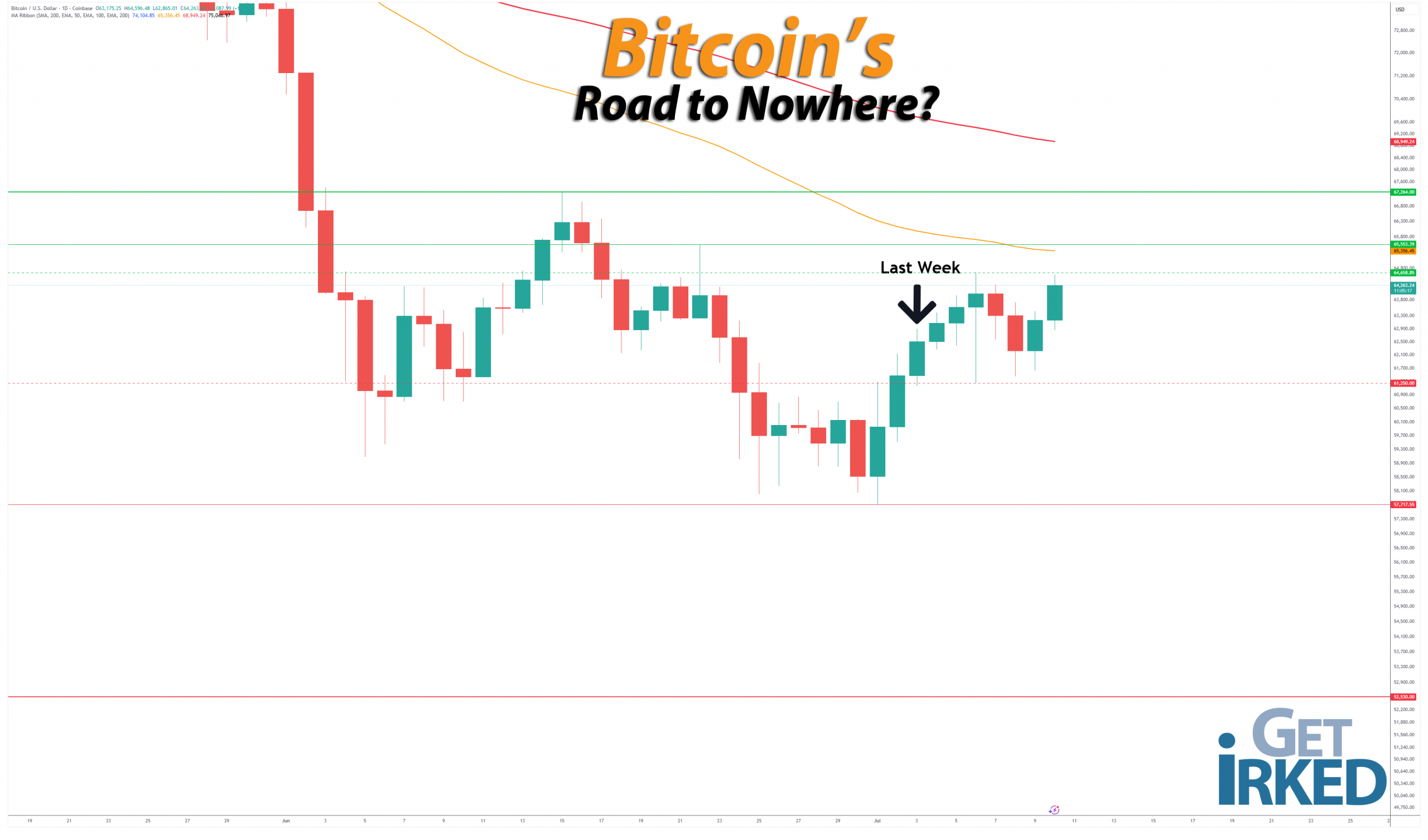
Click chart for enlarged version
Bitcoin Price (in USD)
%
Weekly Change
Bitcoin Price Action
Bitcoin continued the bounce it saw off the cycle low last week, rallying through the weekly high at $62,212.73 but finding resistance on Monday, making a new higher-high at $64,658.85 before quickly being rejected and rolling back over.
Bitcoin made its weekly low on Monday, too, finding support at $61,250.00, giving Monday a more than 5% difference between its high and low; not terribly unusual for Bitcoin, but rare enough that it made some take notice.
From here, retesting - and even breaking through - the 200-Day Simple Moving Average (SMA) currently at $75K wouldn’t be unprecedented. Unfortunately, we’re far from being out of the woods as past Crypto Winters saw Bitcoin break above the 200SMA, look as though it was starting another Bull Market, only to roll over and crash through to all-new lows anywhere from -20% to in excess of -50% lower than what was considered its cycle low prior to the final crash.
As I’ve been saying nearly every week since Bitcoin started this Crypto Winter in January (a selloff of more than -40% from the most recent all-time high signals the start of a Crypto Winter and not just a “garden-variety” pullback for Bitcoin), while this recent price action is Bullish and constructive, Bitcoin’s hit nowhere near the low we need to hit for me to start believing Bitcoin has actually bottomed.
So, that being said…
When could Bitcoin bottom?
For the past few weeks, I’ve discussed different potential bottom price targets for this Crypto Winter, so, if you’re like me and believe the bottom isn’t in for this cycle, when could we expect Bitcoin to break lower and eventually bottom?
In 2015, Bitcoin hit its all-time high on Friday, November 29, 2013 and didn’t bottom until it sold off a total of -86.96% on Tuesday, August 18, 2015, 627 trading days later.
In 2017, Bitcoin hit its all-time high on Sunday, December 17, 2017 and didn’t bottom until it sold off a total of -84.22% on Saturday, December 15, 2018, 363 trading days later.
In 2021, Bitcoin hit its all-time high on Wednesday, November 21, 2021 and didn’t bottom until it sold off a total of -77.57% on Monday, November 21, 2022, 376 trading days later.
So far this cycle, Bitcoin hit its current all-time high on Monday, October 6, 2025 and its current bottom -54.25% lower on July 1, 2026, 268 trading days later.
Clearly, it would be very unlikely that Bitcoin has bottomed in this Crypto Winter both in terms of time and distance.
If like me, you believe we have more downside ahead, I’d look at the two most recent Crypto Winters for guidance and leave out 2013-2015 as it was far longer than we’ve seen, likely due to the collapse of Mt. Gox which was the only exchange in the space at the time.
This gives us an average cycle of ~370 trading days which would mean we could expect a bottom in the first few weeks of October, somewhere around October 10.
When could Bitcoin break to its low?
Now, the break to the final low has happened earlier than the bottoming process in past Crypto Winters. In 2015, Bitcoin’s break started on January 3, 2015 and it hit a low on January 14, 2015 with a drop of -47.32%, 11 trading days later. Granted, the true bottom didn’t happen until August 2015, but it was just -2.67% lower so I would consider the real break to be the one in January.
In 2018, the final break started on November 14, 2018 with Bitcoin selling off -50.38% in 31 trading days to bottom on Saturday, December 15, 2018.
In 2022, the final break started on November 8, 2022 with bitcoin selling off -25.15% before bottoming on November 21, 2022, 13 trading days later.
So, a final break could see Bitcoin sell off anywhere from -25.15% to -50.38% from where it was trading at the time of the break. For the last two Crypto Winters, the break occurred roughly two weeks to a month before the bottom of the cycle (with 2015 seeing a low about 3% higher than the true bottom).
Assuming the current Crypto Winter lasts roughly as long as the last two, that means we could see a break to the final low start somewhere around mid-September. If Bitcoin is trading around the current levels at the time of the break (~$63K), this would give us a price target low somewhere between $30K and $47K.
Of course, it’s important to remember that are absolutely zero certainties in any market, particularly anything to do with Bitcoin and cryptocurrencies. Bitcoin might go far lower than prior cycles. This Crypto Winter might last far longer than prior cycles. Or, Bitcoin could already have bottomed for this cycle.
Only time will tell.
However, for me, all signs say Bitcoin has much, much lower to go from here.
Bitcoin Trade Update
Premium subscribers to Get Irked get access to all the moves I've made in my Bitcoin trade over the past week as well as my next thirty (30) ... yes, 30 ... buys in Bitcoin including price levels, quantities, and a full layout of my ongoing long-term trade in the world's biggest crypto.
Not Your Keys, Not Your Crypto...
In light of brokerage failures in 2022, I no longer keep any of my crypto on an exchange and I only keep enough USD on the exchanges I use to execute my next few buys. I use multiple cold wallets from the brands Ledger and Trezor to hold my crypto (click the links to access the direct sites, and I receive no affiliate benefits from these links).
No price target is unrealistic in the cryptocurrency space – Bullish or Bearish.
While traditional stock market investors and traders may think the price targets in the cryptocurrency space are outlandish due to the incredible spread (possible moves include drops of -90% or more and gains of +1000% or more), Bitcoin has demonstrated that, more than any speculative asset, its price is capable of doing anything.
Here are some of Bitcoin's price movements over the past couple of years:
- In 2017, Bitcoin rose +2,707% from its January low of $734.64 to make an all-time high of $19,891.99 in December.
- Then, Bitcoin crashed nearly -85% from its high to a December 2018 low of $3128.89.
- In the first half of 2019, Bitcoin rallied +343% to $13,868.44.
- In December, Bitcoin crashed -54% to a low of $6430.00 in December 2019.
- In February 2020, Bitcoin rallied +64% to $10,522.51.
- In March , Bitcoin crashed nearly -63% to a low of $3858.00, mostly in 24 hours.
- Then, Bitcoin rallied +988% to a new all-time high of $41,986.37 in January 2021.
- Later in January 2021, Bitcoin dropped -32% to a low of $28,732.00.
- In February, Bitcoin rallied +103% to a new all-time high of $58,367.00.
- Later in February, Bitcoin dropped -26% to a low of $43,016.00.
- In April , Bitcoin rallied +51% to a new all-time high of $64,896.75.
- In June , Bitcoin crashed -56% to a low of $28,800.00.
- In November, Bitcoin rallied +140% to a new all-time high of $69,000.00.
- In November 2022, Bitcoin crashed -78% to a low of $15,460.00.
- In April 2023, Bitcoin rallied +101% to a high of $31,050.00.
- In June, Bitcoin dropped -20% to a low of $24,750.00
- In July, Bitcoin rallied +29% to a high of $31,862.21.
- In September, Bitcoin dropped -22% to a low of $24,900.00.
- In January 2024, Bitcoin rallied +97% to a high of $49,102.29.
- Later in January, Bitcoin dropped -22% to a low of $38,501.00.
- In March, Bitcoin rallied +92% to a new all-time high of $73,835.57.
- In August, Bitcoin dropped -33% to a low of $49,050.01.
- In January 2025, Bitcoin rallied +150% to a new all-time high of $109,358.01.
- In April, Bitcoin dropped -32% to a low of $74,420.69.
- In May, Bitcoin rallied +51% to a new all-time high of $112,000.00.
- In June, Bitcoin dropped -12% to a low of $98,247.01.
- In July, Bitcoin rallied +25% to a new all-time high of $123,231.07.
- In September, Bitcoin dropped -14% to a low of $107,250.00.
- In October, Bitcoin rallied +18% to a new all-time high of $126,296.00.
- In July 2026, Bitcoin dropped -54% to a low of $57,717.55.
Where will Bitcoin go from here? Truly, anything is possible…
What if Bitcoin’s headed to zero?
The only reason I speculate in the cryptocurrency space is I truly believe Bitcoin isn’t headed to zero.
I am prepared for that possibility, however, by knowing I could potentially lose all of the capital I’ve allocated to this speculative investment. Professional advisers recommend speculating with no more than 5% of an investor’s overall assets. Personally, I’ve allocated less than that to speculating in crypto.
I feel that anyone who doesn’t fully believe in the long-term viability of cryptocurrency would be better served not speculating in the space.
On a good day, this asset class isn’t suitable for those with weak stomachs. On volatile days, the sector can induce nausea in the most iron-willed speculator. If a speculator isn’t confident in the space, the moves will cause mistakes to be made.
DISCLAIMER: Anyone considering speculating in the crypto sector should only do so with funds they are prepared to lose completely. All interested individuals should consult a professional financial adviser to see if speculation is right for them. No Get Irked contributor is a financial professional of any kind.
Ways to give back to GetIrked:
Send me a tip via Stripe! Thank you!
Get free money by signing up for an account with my referral link for Schwab
Sign up for Gemini and we each get $10
Click this referral link to get the Brave Browser
If you use Brave, you can also use the Tip function to tip me in Basic Attention Token (BAT).
Suicide Hotline - You Are Not Alone
Studies show that economic recessions cause an increase in suicide, especially when combined with thoughts of loneliness and anxiety.
If you or someone you know are having thoughts of suicide or self-harm, please contact the National Suicide Prevention Lifeline by visiting www.suicidepreventionlifeline.org or calling 1-800-273-TALK.
The hotline is open 24 hours a day, 7 days a week.

You must be logged in to post a comment.