

Summing Up The Week
The stock market headed into the week bracing for another round of geopolitical whiplash as conflicts from Eastern Europe to the Middle East collided with fresh inflation data and a fragile energy backdrop.
Russia vowed "massive group strikes" after Ukraine’s largest drone attack on Moscow to date, U.S.–Iran peace efforts stalled amid missed meetings and renewed Israeli–Lebanese clashes, and Iran once again claimed to close the Strait of Hormuz just as tanker traffic had begun to recover.
Yet, even with core inflation ticking up to 3.4% - the highest level since late 2023 - the Nasdaq found its footing thanks to a blowout earnings surprise from Micron (MU) underscoring the market’s uncanny ability to shrug off chaos when tech delivers.
Let's take a deeper dive into the news that moved markets this week...
Market News
Russia threatens escalation after Ukraine attacks Moscow
On Friday, Russia pledged "massive group strikes" against Ukraine after its largest-ever drone attack severely damaged a major oil refinery on the outskirts of Moscow, reported CNBC. Almost 200 drones were used in the attack which made it Ukraine's largest raid on Moscow with authorities reporting 16 people injured and four Moscow airports temporarily shutting down flights.
As a result, Russia declared retaliation would be warranted. "It is no coincidence that the president announced some time ago, after yet another Kyiv terrorist attack, that we will now conduct massive group strikes on a regular basis against targets whose condition directly affects the combat readiness of the Ukrainian Armed Forces," Russian Foreign Minister Sergei Lavrov told reporters.
U.S.-Iran accord hits snag after Swiss talks fail to proceed
On Friday, the White House announced Vice President JD Vance would no longer travel to Switzerland casting doubts on the U.S.-Iran discussions while Israel struck Lebanon before agreeing to a ceasefire, reported CNBC. The failure to engage in further discussions highlighted additional confusion and uncertainty regarding any potential lasting peace deal as well as the interim Memorandum of Understanding (MoU).
The White House blamed logistical problems for Vance's absence. "The plans for the upcoming technical talks have not been finalized, and the U.S. delegation has been prepared to depart at the first available opportunity," a White House spokesperson said. "But the logistics of these negotiations have never been simple or predictable."
Under the 14-point MoU, both sides agreed to extend the ceasefire, including in Lebanon, and reopen the strategically vital Strait of Hormuz. However, Israel launched a wave of air strikes against Lebanon after the MoU's signing. Lebanon’s Health Ministry said 18 people were killed in the south of the country. Israel said four of its soldiers were also killed.
Israeli Prime Minister Benjamin Netanyahu said in a social media post Friday morning that he instructed the Israel Defense Forces to strike Hezbollah "with full force" in response to a "heinous attack" by the Iran-backed group.
Oil tanker traffic returns in Strait of Hormuz
Starting last Thursday, at least 20 VLCC (Very Large Crude Carrier) oil tankers traveled through the Strait of Hormuz, the highest level of traffic since June 2, reported CNBC. While this is a move in the right direction, 20 is still a far cry from the 100+ ships which traversed the strait each day prior to the start of the U.S.-Iran War.
That being said, the Trump Administration commended the Iranians for "honoring their end of the commitment" according to Vice President JD Vance in a press conference in the evening last Thursday.
"Traffic was broadly balanced, with 13 crossings moving West to East and 12 moving East to West," said Matt Smith, Kpler’s Commodity Research Director. "Two-way vessel flows suggest Iranian crude trade is gradually returning closer to normal operating patterns."
Iran reportedly closes Strait of Hormuz again
On Saturday, the ongoing confusion over the U.S.-Iran peace talks continued when Iran declared the Strait of Hormuz closed again and warned vessels to stay away, reported CNBC. The U.S. attempted to deny Iran's claims, citing that the waterway continued to remain open.
The announcement by Iran’s military and the country’s Islamic Revolutionary Guard Corps came as Iranian negotiators prepared to travel to Switzerland for technical-level talks with U.S. officials scheduled to begin Sunday.
Iran’s joint military command said the closure of the strait was in response to continued Israeli military operations in Lebanon and what it described as U.S. "bad faith" and a failure to uphold commitments under the truce framework, AP reported. Iranian state television said "subsequent steps have been planned" if what it called aggression continues, according to multiple outlets.
With the ability to ship oil through the strait remaining in question for the foreseeable future, analysts pondered what reaction the markets would have when they reopened the following Monday.
Core inflation hits 3.4% in May, highest since October 2023
On Thursday, the Personal Consumption Expenditures (PCE) index - the Federal Reserve's preferred gauge of inflation - showed core inflation rose 0.3% in June to an annual rate of 3.4% - its highest since October 2023 - which was in-line with Dow Jones' estimates, reported CNBC.
The key element to remember about core inflation is that it excludes food and energy, the two most volatile components of inflation, so a higher core inflation number truly indicates an increase in the rate of inflation on a real level. Personal consumption expenditures serve as a proxy for consumer spending and those rose 0.7% for the month, 0.1% higher than the forecast.
The markets shrugged off the report, however, as Micron's (MU) earnings from the night before blew away expectations so strongly that the earnings alone reversed the 3-day rout the Nasdaq had been in prior to Thursday's market open.
Next Week's Gameplan
Next week brings yet another holiday-shortened trading week with markets closed on Friday to observe the United States' 250th Independence Day celebration. That doesn't mean the week's without its datapoints, however, as we'll get consumer confidence on Tuesday; ADP employment figures on Wednesday; and the Bureau of Labor Statistics (BLS) will release its jobs report for June a day early on Thursday.
So, with plenty to keep us busy and next week marking the end of both the month and the quarter, I'm sure we'll have a lot to talk about when we meet back here next Thursday, friends!
Check out Get Irked Premium on Substack!
After providing FREE content since 2018, the time constraints of producing Investments in Play, Speculation in Play, the Pandemic Portfolio, and Stock Shopping List have become too much to continue doing for free.
On Substack, you can subscribe for FREE to have the Week in Review and Crypto Corner, now separate newsletters, sent to your email inbox at no cost. The portfolio updates and Stock Shopping List are now part of a premium subscription plan.
I hope you will join me on Substack as I continue on this exciting journey!
THANK YOU FOR YOUR ONGOING SUPPORT!
Crytpo Corner
Click chart for enlarged version
Bitcoin Price (in USD)
%
Weekly Change
Bitcoin Price Action
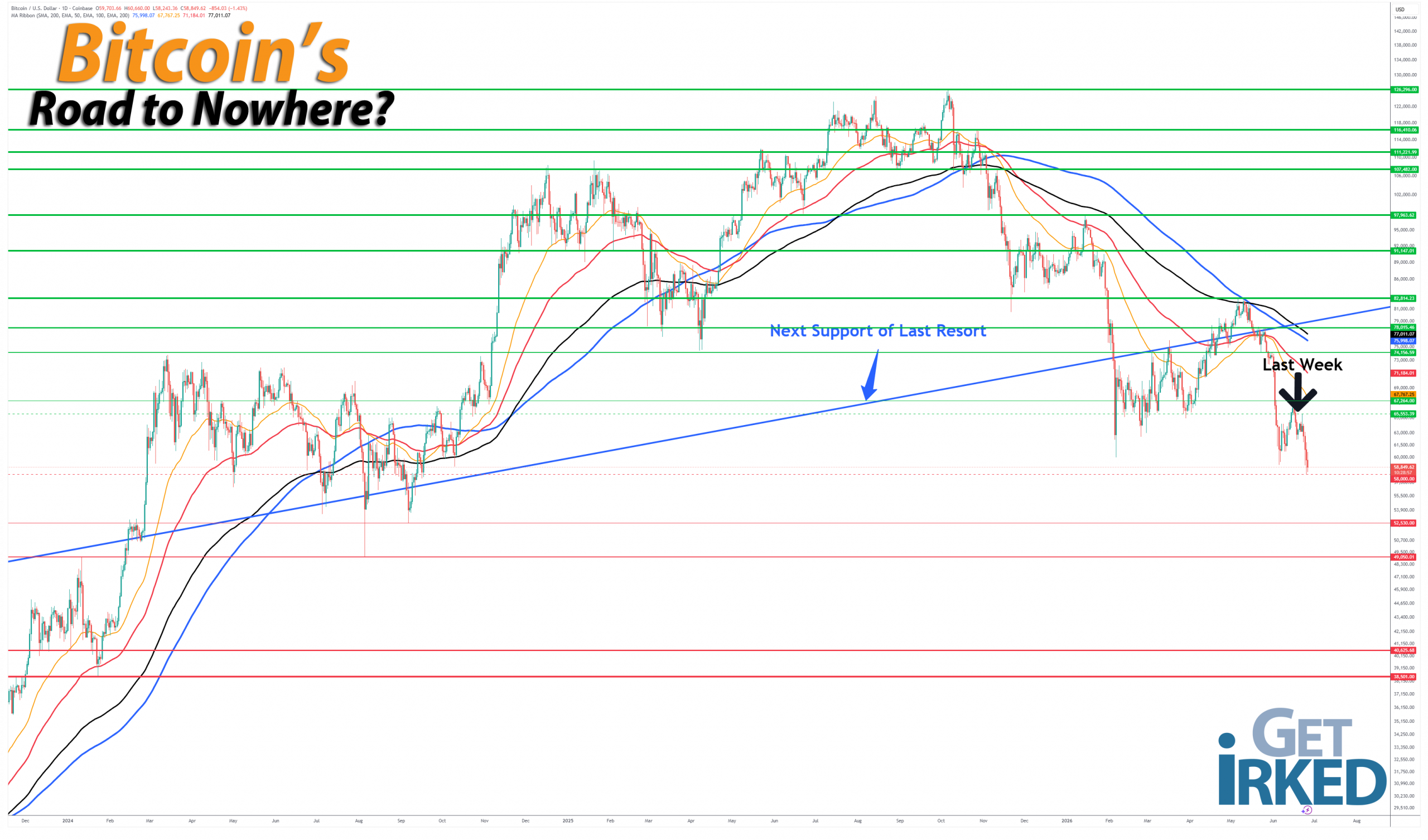
Bitcoin chose the worst possible time to re-correlate with gold just as investors decided to dump the “pet rock” for greener pastures. As gold crashed to new lows below $4,000/oz on Wednesday, so did Bitcoin, breaking below the cycle low to levels last seen in October. However, that was where the correlation to gold once again broke with gold rallying on Thursday and Bitcoin selling off even further with a new cycle low at $58,000.00.
Bitcoin’s weekly high didn’t offer much hope for the Bulls, either, as Bitcoin barely made it to $65,553.99 - much lower than last week’s anemic high of $67,264.00 - and further cementing a series of sickeningly lower-highs and lower-lows.
The price action isn’t good for anyone feeling Bullish, friends. In fact, it remains incredibly reminiscent of the summer of 2018 where Bitcoin briefly broke support at $6,000, an indication the bottom wasn’t in when a few months later, in November, it fell nearly another -50% to the cycle low of ~$3,130.
Yes, I continue to side with the Bears and feel that a cycle low in the $30K-$40K region is the likely outcome (with a break below $30K very possible) despite Bulls arguing that Bitcoin can’t possibly drop below $45K as the worst case scenario.
Where were we exactly eight years ago?
I was reviewing charts and noticed we may be exactly at the point in the 2018 market where Bitcoin briefly broke below $6000 before finding support at $5650, and, guess what, it happened to be eight years ago to almost the exact day: June 24, 2018.
After that, Bitcoin would crash -44.78% from that low before bottoming in December around $3,100. A proportionally similar move now would give us a bottom price target of $32,045.83.
How low do Crypto Winters go?
Let’s try a different approach.
Each Crypto Winter is shallower than the last, however not by much.
2018's Crypto Winter was a crash of -84.13% from peak to trough.
2022's Crypto Winter was a crash of -77.58% from peak to trough.
And it goes back like that to Bitcoin’s beginning.
Since 2022’s total drop was -6.55% shallower than 2018’s, we could come up with an estimate of a -72.50% crash this time by taking -6.55% from -77.58%.
What’s our bottom price target by December 2026 using this math?
$34,650.
Yes, it’s starting to get exciting, sports fans!
The Bullish Case
Bulls point to the small break between the prior low of $59,073.01 and our current low as a sign of strength, suggesting that buyers are willing to come in to protect that level which indicates a sign of strength. Many of these Bulls continue to believe the low is in for this Crypto Winter and it’s simply a matter of time before the rest of the market “comes to its senses” to jumpstart the next Bull Market in Bitcoin.
However, the reality of the matter is this: if a support level is tested repeatedly in any class, that is not a sign of strength. Most levels of support can only be tested twice. If they are tested a third time, they break.
… and that’s exactly what we saw this week as the $60K level was tested a third time, didn’t hold, and broke to new lows. That will likely to continue happening from here, too.
The Bearish Case
Bears retain the upper hand as they have for months now - Bitcoin’s downtrend is worsening, not improving. Rather than being constructive, the rudimentary and elementary series of lower-highs and lower-lows is clear: unless something dramatically changes in the climate around Bitcoin and the rest of the cryptocurrency sector, this winter is far from over.
Bitcoin Trade Update
Premium subscribers to Get Irked get access to all the moves I've made in my Bitcoin trade over the past week as well as my next thirty (30) ... yes, 30 ... buys in Bitcoin including price levels, quantities, and a full layout of my ongoing long-term trade in the world's biggest crypto.
Not Your Keys, Not Your Crypto...
In light of brokerage failures in 2022, I no longer keep any of my crypto on an exchange and I only keep enough USD on the exchanges I use to execute my next few buys. I use multiple cold wallets from the brands Ledger and Trezor to hold my crypto (click the links to access the direct sites, and I receive no affiliate benefits from these links).
No price target is unrealistic in the cryptocurrency space – Bullish or Bearish.
While traditional stock market investors and traders may think the price targets in the cryptocurrency space are outlandish due to the incredible spread (possible moves include drops of -90% or more and gains of +1000% or more), Bitcoin has demonstrated that, more than any speculative asset, its price is capable of doing anything.
Here are some of Bitcoin's price movements over the past couple of years:
- In 2017, Bitcoin rose +2,707% from its January low of $734.64 to make an all-time high of $19,891.99 in December.
- Then, Bitcoin crashed nearly -85% from its high to a December 2018 low of $3128.89.
- In the first half of 2019, Bitcoin rallied +343% to $13,868.44.
- In December, Bitcoin crashed -54% to a low of $6430.00 in December 2019.
- In February 2020, Bitcoin rallied +64% to $10,522.51.
- In March , Bitcoin crashed nearly -63% to a low of $3858.00, mostly in 24 hours.
- Then, Bitcoin rallied +988% to a new all-time high of $41,986.37 in January 2021.
- Later in January 2021, Bitcoin dropped -32% to a low of $28,732.00.
- In February, Bitcoin rallied +103% to a new all-time high of $58,367.00.
- Later in February, Bitcoin dropped -26% to a low of $43,016.00.
- In April , Bitcoin rallied +51% to a new all-time high of $64,896.75.
- In June , Bitcoin crashed -56% to a low of $28,800.00.
- In November, Bitcoin rallied +140% to a new all-time high of $69,000.00.
- In November 2022, Bitcoin crashed -78% to a low of $15,460.00.
- In April 2023, Bitcoin rallied +101% to a high of $31,050.00.
- In June, Bitcoin dropped -20% to a low of $24,750.00
- In July, Bitcoin rallied +29% to a high of $31,862.21.
- In September, Bitcoin dropped -22% to a low of $24,900.00.
- In January 2024, Bitcoin rallied +97% to a high of $49,102.29.
- Later in January, Bitcoin dropped -22% to a low of $38,501.00.
- In March, Bitcoin rallied +92% to a new all-time high of $73,835.57.
- In August, Bitcoin dropped -33% to a low of $49,050.01.
- In January 2025, Bitcoin rallied +150% to a new all-time high of $109,358.01.
- In April, Bitcoin dropped -32% to a low of $74,420.69.
- In May, Bitcoin rallied +51% to a new all-time high of $112,000.00.
- In June, Bitcoin dropped -12% to a low of $98,247.01.
- In July, Bitcoin rallied +25% to a new all-time high of $123,231.07.
- In September, Bitcoin dropped -14% to a low of $107,250.00.
- In October, Bitcoin rallied +18% to a new all-time high of $126,296.00.
- In June 2026, Bitcoin dropped -54% to a low of $58,000.00.
Where will Bitcoin go from here? Truly, anything is possible…
What if Bitcoin’s headed to zero?
The only reason I speculate in the cryptocurrency space is I truly believe Bitcoin isn’t headed to zero.
I am prepared for that possibility, however, by knowing I could potentially lose all of the capital I’ve allocated to this speculative investment. Professional advisers recommend speculating with no more than 5% of an investor’s overall assets. Personally, I’ve allocated less than that to speculating in crypto.
I feel that anyone who doesn’t fully believe in the long-term viability of cryptocurrency would be better served not speculating in the space.
On a good day, this asset class isn’t suitable for those with weak stomachs. On volatile days, the sector can induce nausea in the most iron-willed speculator. If a speculator isn’t confident in the space, the moves will cause mistakes to be made.
DISCLAIMER: Anyone considering speculating in the crypto sector should only do so with funds they are prepared to lose completely. All interested individuals should consult a professional financial adviser to see if speculation is right for them. No Get Irked contributor is a financial professional of any kind.
Ways to give back to GetIrked:
Send me a tip via Stripe! Thank you!
Get free money by signing up for an account with my referral link for Schwab
Sign up for Gemini and we each get $10
Click this referral link to get the Brave Browser
If you use Brave, you can also use the Tip function to tip me in Basic Attention Token (BAT).
Suicide Hotline - You Are Not Alone
Studies show that economic recessions cause an increase in suicide, especially when combined with thoughts of loneliness and anxiety.
If you or someone you know are having thoughts of suicide or self-harm, please contact the National Suicide Prevention Lifeline by visiting www.suicidepreventionlifeline.org or calling 1-800-273-TALK.
The hotline is open 24 hours a day, 7 days a week.

You must be logged in to post a comment.