

Summing Up The Week
The week delivered yet another whiplash blend of economic resilience and geopolitical chaos, leaving the stock market lurching between panic and euphoria.
A stronger‑than‑expected March jobs report briefly steadied nerves, but the Iran War continued to dominate sentiment as ceasefire rumors, threats, agreements, and accusations ricocheted across headlines.
Oil prices plunged after a surprise two‑week truce reopened the Strait of Hormuz, igniting a massive equity rally, only for inflation data and fresh Iranian claims of U.S. violations to cool enthusiasm.
With consumer confidence collapsing to record lows and inflation stuck at 3% thanks to wartime energy shocks, investors spent the week trying to price a world where the labor market is firm, the Fed still hints at a 2026 cut, and geopolitics remain the market’s true puppet master.
Let’s take a deeper dive into the news that moved markets this week…
Market News
U.S. jobs rose 178K in March, more than expected
Last Friday, the Bureau of Labor Statistics (BLS) released the March payrolls report which showed an increase of 178,000 jobs, more than the 59,000 estimated by Dow Jones, while unemployment lowered slightly to 4.3%, reported CNBC. The strange anachronistic element of the stock market still observing Good Friday as a holiday meant there was no tangible reaction in equities, but the bond market which, oddly, does still trade on Good Friday, saw Treasury yields head higher at the close.
Pundits did point to a seeming lack of hiring as a factor to watch heading forward. "The bottom line is March was somewhat encouraging, but it’s been a rocky year for the labor market with almost no hiring since last April," said Heather Long, Chief Economist at Navy Federal Credit Union. "The March data will keep the Federal Reserve on hold, but no one is declaring victory yet. It’s likely to be a tough spring for job seekers."
That being said, a strong labor market means the Federal Reserve has no reason to cut interest rates, particularly with the potential of a wave of inflation due to rising energy prices as a result of the Iran War.
Iran studies ceasefire plan
Following a particularly aggressive TruthSocial post on Sunday, Iranian leaders were reported to be reviewing the U.S.'s ceasefire plan ahead of Trump's deadline on Monday, reported CNBC. The framework of the plan would hopefully end the five-week-old conflict prior to Trump's threats that the U.S. would obliterate civilian infrastructure on Tuesday if the Strait of Hormuz remained closed.
A source stated intermediaries, including Field Marshal Asim Munir from Pakistan in association with Vice President JD Vance, Special Envoy Steve Witkoff, and Iranian Foreign Minister Abbas Araqchi, that they were working "all night long" to reach a deal.
Iranian ministry spokesperson Esmaeil Baghaei said details of the response would be announced in due time, but added negotiations were "incompatible with ultimatums and threats to commit war crimes."
"Iran does not hesitate to clearly express what it considers its legitimate demands and doing so should not be interpreted as a sign of compromise, but rather as a reflection of its confidence in defending its positions," said Baghaei at a press conference. He said earlier U.S. demands, such as a 15-point plan, were rejected for being excessive.
US-Iran agree to two-week ceasefire with plan to open Strait of Hormuz
On Tuesday evening, President Donald Trump announced that he agreed to suspend attacks on Iran for two weeks after conversations with Iranian leadership resulted in a cease-fire along with a plan to reopen the Strait of Hormuz, reported CNBC. Following the announcement, the price of oil fell 16% while equity futures roared back to life.
In confirmation, Iran Foreign Minister Abbas Araghchi said in a separate statement that ships will be able to safely pass through the strait for the two-week interval "via coordination with Iran’s Armed Forces and with due consideration of technical limitations."
The Fed still foresees at least one rate cut in 2026
On Wednesday, the minutes from the Federal Reserve's March meeting show the committee still sees at least one additional rate cut in 2026 despite any potential impact from the Iran War, reported CNBC.
Most of the committee members said the war could result in the need for easier monetary policy if rising gas prices hit consumer wallets, according to the minutes, "Many participants judged that, in time, it would likely become appropriate to lower the target range for the federal funds rate if inflation were to decline in line with their expectations."
Iran claims U.S. violated ceasefire agreement
On Wednesday afternoon, Iran parliamentary speaker Mohammad Bagher Ghalibaf accused the United States of violating the ceasefire agreement, reported CNBC. Three parts of Iran’s 10-point ceasefire proposal have been violated, Ghalibaf said: The violations are Israel’s continued attacks on Lebanon, the entry of a drone into Iranian airspace, and the denial of the Islamic Republic’s right to enrich uranium.
"In such situation, a bilateral ceasefire or negotiations is unreasonable," the parliamentary speaker said. President Donald Trump said Tuesday that Iran’s proposal was a workable basis for negotiations. Despite Ghalibaf's commentary coming out before the market closed, stocks maintained their explosive rally with the S&P 500 closing up more than 2.50% and the Nasdaq closing up nearly 3.00% on the day.
Inflation stuck at 3% thanks to Iran War
On Thursday, the Personal Consumption Expenditures (PCE) index, the Federal Reserve's preferred gauge of inflation, showed the annual rate of inflation stuck at 3.00% in March due to the inflation shocked caused by the war in Iran which was in-line with the Dow Jones estimates, reported CNBC.
In addition to the inflation readings, the report also showed consumer spending unexpectedly down 0.1% on the month, while personal income rose 0.4%. Economists had expected spending to rise 0.6% with income up 0.4%. The drop in consumer spending is likely due to expectations of incoming inflation as well as the much more immediate effects of skyrocketing gas prices.
For example, in the Pacific Northwest where I live, the cost of a gallon of premium gas (my cars are thirsty little monkeys) rose from $3.95/gal to $5.95/gal. That kind of price shock certainly impacts consumers' mindsets when it comes to how they plan to spend in the near- to moderate-term future.
Some analysts have found a corollary between the current price shock and the 1970s inflation spike, "February prices were in line but income was weak and GDP was revised down again. That means stagflation was a little worse than expected even before the Iran war started," said David Russell, Global Head of Market Strategy at TradeStation. "Parallels to the 1970s might be growing as investors assess this fragile ceasefire."
Following Wednesday's explosive rally which saw the S&P 500 close up more than +2.50% and the Nasdaq up nearly +3%, Thursday saw both indexes pull back slightly before the open following the release of the PCE and news that Iran accused the U.S. of already breaking the ceasefire agreement.
Consumer confidence hits record low over Iran War
On Friday, the University of Michigan's sentiment survey showed consumer confidence had dropped to 47.6%, its lowest-ever recorded level, from 10.7% over fears of the impact of the Iran War, reported CNBC.
Respondents' comments "show that many consumers blame the Iran conflict for unfavorable changes to the economy," said Survey Director Joanne Hsu. "[However,] economic expectations will likely improve after consumers gain confidence that the supply disruptions stemming from the Iran conflict have ended and gas prices have moderated."
Next Week's Gameplan
Next week brings more inflation data with the Producer Price Index (PPI) for March coming out on Tuesday, We get more insight into the housing market with the Home Builder Confidence Index on Wednesday as well as Housing Starts on Friday. All that being said, there isn't much on the docket in terms of expected datapoints.
The wild ride in Iran promises to continue, however, as it appears there will be plenty of he-said, he-said disagreements between the two countries over the ceasefire agreement. In other words, anticipate continued volatility in both directions in the days ahead.
And, as always, I'll meet you back here next Friday to go over all the week's details!
Check out Get Irked Premium on Substack!
After providing FREE content since 2018, the time constraints of producing Investments in Play, Speculation in Play, the Pandemic Portfolio, and Stock Shopping List have become too much to continue doing for free.
On Substack, you can subscribe for FREE to have the Week in Review and Crypto Corner, now separate newsletters, sent to your email inbox at no cost. The portfolio updates and Stock Shopping List are now part of a premium subscription plan.
I hope you will join me on Substack as I continue on this exciting journey!
THANK YOU FOR YOUR ONGOING SUPPORT!
Crytpo Corner
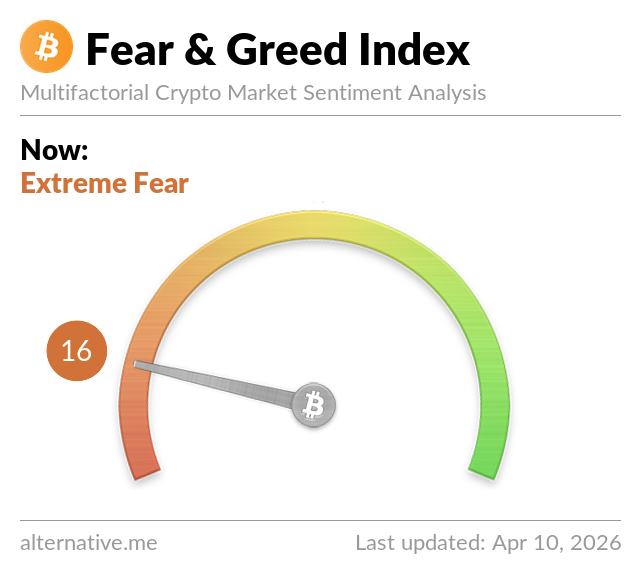
Click chart for enlarged version
Bitcoin Price (in USD)
%
Weekly Change
Bitcoin Price Action
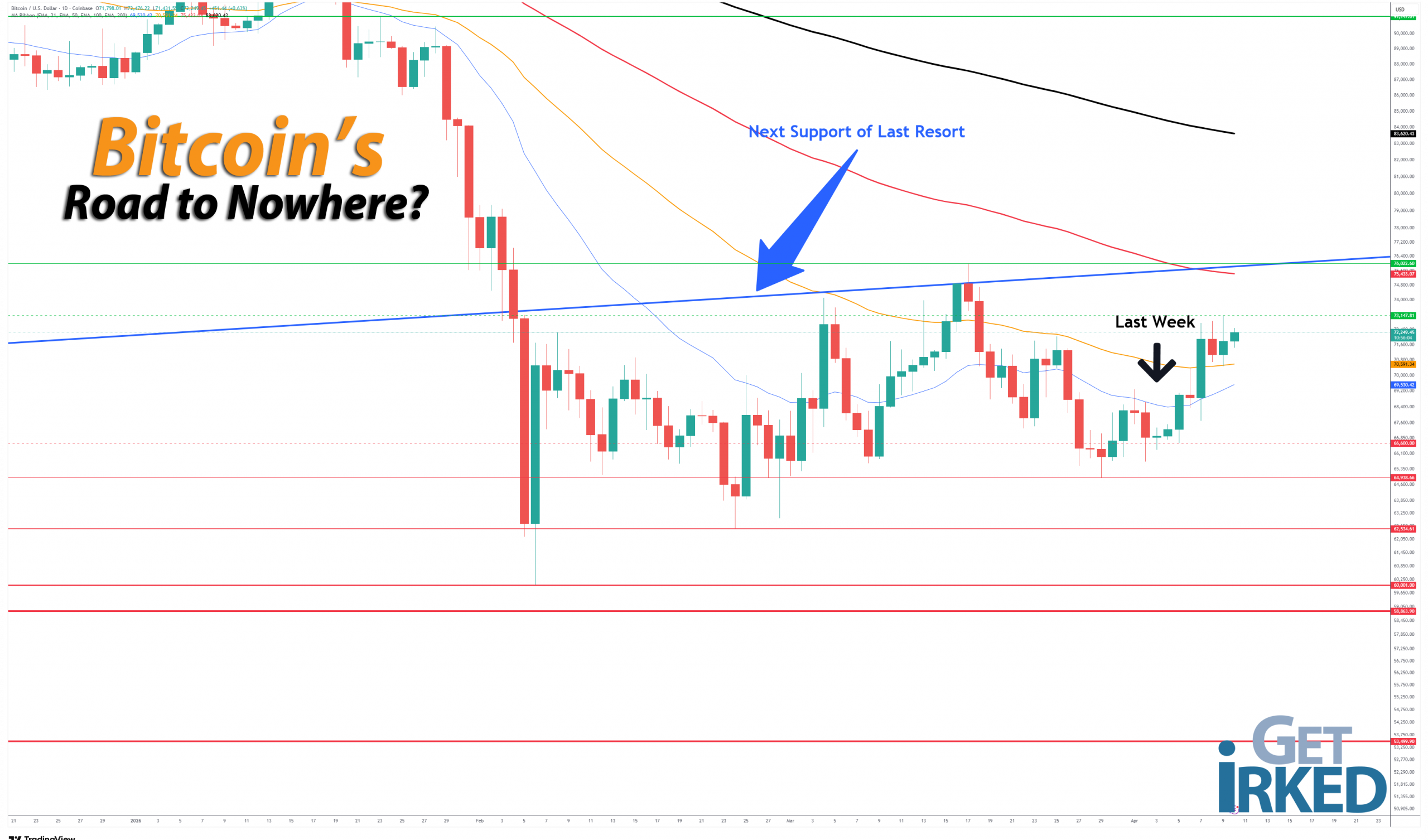
Bitcoin was able to break through last week’s high at $69,285.99 as well as resistance from the preceding week at $72,030.29 as a result of the announcement of the U.S.-Iran ceasefire on Wednesday with the world’s largest crypto not encountering resistance until $73,147.81. Additionally, Bitcoin was also able to make a higher weekly-low at $66,600.00 during a brief pullback over the weekend on Sunday.
While that’s Bullish price action over the short-term, we’re still a far cry from breaking through the $76,022.60 high Bitcoin made in mid-March. With both the 100-Day Exponential Moving Average (EMA) and the Next Support of Last Resort trendline cutting below that mid-March high, the Bulls will have even more upside resistance to contend with as they try to push Bitcoin higher from here.
However, despite all of the Bears (including me) warning of incoming lower-lows and that this Crypto Winter hasn’t bottomed, Bitcoin sure has held the range like a champ. Sure, it hasn’t broken out to the upside, but it also clearly hasn’t broken down.
In other words, the verdict is still not in. Until Bitcoin breaks through $76,022.60 on the upside or breaks below $64,938.66 (followed by $62,534.61 and $60,001.00) on the downside, this is still anyone’s game.
The Bullish Case
Bulls have become voracious after Michael Saylor’s Strategy (MSTR) bought a significant quantity of Bitcoin claiming that his buying indicates the bottom. These Bulls believe Bitcoin’s current period of consolidation is similar to the consolidation between late 2018 and early 2019 shortly before Bitcoin shot from its December 2018 low at $3,130 to its 2021 high of nearly $70K. These Bulls argue there is significant upside and no downside risk from here.
The Bearish Case
Bears counter the Bulls’ argument of Saylor’s Bitcoin purchase by rightfully pointing out if it was such a Bullish buy, why didn’t Bitcoin break out? Why is Bitcoin nowhere near the $76,022.60 high it made in mid-March? Instead of marking the bottom, Bears warn that if Strategy’s big buy couldn’t cause Bitcoin to break out, instead the buyers are exhausted and Bitcoin’s about to flush out the hot hands who just jumped in on its way to breaking the $60K barrier.
Bitcoin Trade Update
Premium subscribers to Get Irked get access to all the moves I've made in my Bitcoin trade over the past week as well as my next thirty (30) ... yes, 30 ... buys in Bitcoin including price levels, quantities, and a full layout of my ongoing long-term trade in the world's biggest crypto.
Not Your Keys, Not Your Crypto...
In light of brokerage failures in 2022, I no longer keep any of my crypto on an exchange and I only keep enough USD on the exchanges I use to execute my next few buys. I use multiple cold wallets from the brands Ledger and Trezor to hold my crypto (click the links to access the direct sites, and I receive no affiliate benefits from these links).
Additionally, I have now divided my allocated USD between two different exchanges - Gemini and Coinbase - in case one (or both) becomes insolvent. Disclaimer: We both receive a bonus if you use my Gemini referral link to open an account.
I do not trust anyone in the space, even with Coinbase (COIN) being publicly traded (and one of my own Investments in Play positions).
No price target is unrealistic in the cryptocurrency space – Bullish or Bearish.
While traditional stock market investors and traders may think the price targets in the cryptocurrency space are outlandish due to the incredible spread (possible moves include drops of -90% or more and gains of +1000% or more), Bitcoin has demonstrated that, more than any speculative asset, its price is capable of doing anything.
Here are some of Bitcoin's price movements over the past couple of years:
- In 2017, Bitcoin rose +2,707% from its January low of $734.64 to make an all-time high of $19,891.99 in December.
- Then, Bitcoin crashed nearly -85% from its high to a December 2018 low of $3128.89.
- In the first half of 2019, Bitcoin rallied +343% to $13,868.44.
- In December, Bitcoin crashed -54% to a low of $6430.00 in December 2019.
- In February 2020, Bitcoin rallied +64% to $10,522.51.
- In March , Bitcoin crashed nearly -63% to a low of $3858.00, mostly in 24 hours.
- Then, Bitcoin rallied +988% to a new all-time high of $41,986.37 in January 2021.
- Later in January 2021, Bitcoin dropped -32% to a low of $28,732.00.
- In February, Bitcoin rallied +103% to a new all-time high of $58,367.00.
- Later in February, Bitcoin dropped -26% to a low of $43,016.00.
- In April , Bitcoin rallied +51% to a new all-time high of $64,896.75.
- In June , Bitcoin crashed -56% to a low of $28,800.00.
- In November, Bitcoin rallied +140% to a new all-time high of $69,000.00.
- In November 2022, Bitcoin crashed -78% to a low of $15,460.00.
- In April 2023, Bitcoin rallied +101% to a high of $31,050.00.
- In June, Bitcoin dropped -20% to a low of $24,750.00
- In July, Bitcoin rallied +29% to a high of $31,862.21.
- In September, Bitcoin dropped -22% to a low of $24,900.00.
- In January 2024, Bitcoin rallied +97% to a high of $49,102.29.
- Later in January, Bitcoin dropped -22% to a low of $38,501.00.
- In March, Bitcoin rallied +92% to a new all-time high of $73,835.57.
- In August, Bitcoin dropped -33% to a low of $49,050.01.
- In January 2025, Bitcoin rallied +150% to a new all-time high of $109,358.01.
- In April, Bitcoin dropped -32% to a low of $74,420.69.
- In May, Bitcoin rallied +51% to a new all-time high of $112,000.00.
- In June, Bitcoin dropped -12% to a low of $98,247.01.
- In July, Bitcoin rallied +25% to a new all-time high of $123,231.07.
- In September, Bitcoin dropped -14% to a low of $107,250.00.
- In October, Bitcoin rallied +18% to a new all-time high of $126,296.00.
- In February 2026, Bitcoin dropped -53% to a low of $60,001.00.
Where will Bitcoin go from here? Truly, anything is possible…
What if Bitcoin’s headed to zero?
The only reason I speculate in the cryptocurrency space is I truly believe Bitcoin isn’t headed to zero.
I am prepared for that possibility, however, by knowing I could potentially lose all of the capital I’ve allocated to this speculative investment. Professional advisers recommend speculating with no more than 5% of an investor’s overall assets. Personally, I’ve allocated less than that to speculating in crypto.
I feel that anyone who doesn’t fully believe in the long-term viability of cryptocurrency would be better served not speculating in the space.
On a good day, this asset class isn’t suitable for those with weak stomachs. On volatile days, the sector can induce nausea in the most iron-willed speculator. If a speculator isn’t confident in the space, the moves will cause mistakes to be made.
DISCLAIMER: Anyone considering speculating in the crypto sector should only do so with funds they are prepared to lose completely. All interested individuals should consult a professional financial adviser to see if speculation is right for them. No Get Irked contributor is a financial professional of any kind.
Suicide Hotline - You Are Not Alone
Studies show that economic recessions cause an increase in suicide, especially when combined with thoughts of loneliness and anxiety.
If you or someone you know are having thoughts of suicide or self-harm, please contact the National Suicide Prevention Lifeline by visiting www.suicidepreventionlifeline.org or calling 1-800-273-TALK.
The hotline is open 24 hours a day, 7 days a week.

You must be logged in to post a comment.